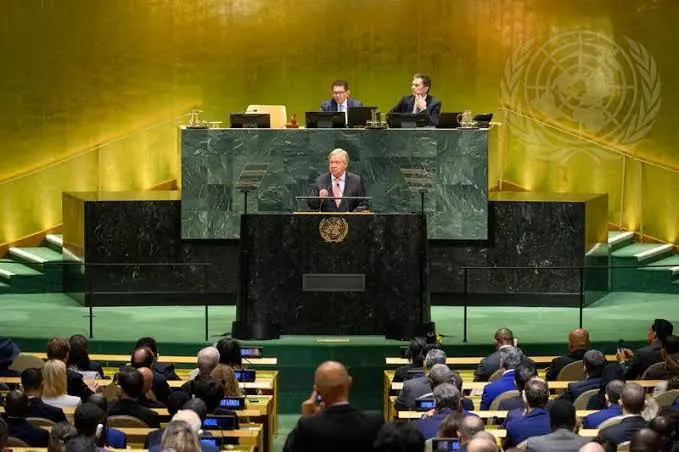
The United Nations General Assembly (UNGA) recently convened in New York, with African leaders taking to the rostrum to voice their concerns about the continent's lack of representation on the UN Security Council. For years, African leaders have been repeating the same mantra: that Africa deserves a seat at the table. However, critics argue that this approach has been ineffective, with some describing the UNGA as a "theatre of nations" where speeches are crafted to expose hypocrisy, but ultimately, little changes.
Kenya's President William Ruto was among the African leaders who spoke at the UNGA, reiterating the familiar indictment that "the equality proclaimed in this assembly ends at the doors of the Security Council." While Ruto's sentiments were well-received, some argue that being right is not the same as being powerful. The UN Security Council has five permanent seats with veto power, none of which are held by African countries. Two European countries, France and the UK, wield these powers, a situation that has been criticized by many as unfair.
The Ezulwini Consensus, adopted by the African Union in 2005, demanded two permanent UNSC seats with veto power and two additional elected seats for Africa. Despite repeated calls for reform, the situation remains unchanged. Critics argue that African leaders have been approaching the issue incorrectly, with some suggesting that they should withdraw their deference to the current system and build leverage or create alternative platforms.
The issue of African representation on the UN Security Council is complex, with some arguing that it is not just about having a seat, but about the power and influence that comes with it. African leaders have been accused of being gatekeepers for Western imperialism, with some, such as Nigeria's Tinubu, being criticized for prioritizing relationships with Western powers over the interests of their own citizens.
The case of Agnes Wanjiru, a Kenyan woman who was allegedly killed by British troops in 2012, highlights the complexities of African sovereignty. Despite Kenya's independence, the country still hosts British troops, with some arguing that this undermines its sovereignty. President Ruto's speech at the UNGA, which criticized the international order, has been seen as hypocritical by some, given Kenya's continued relationship with British troops.
The issue of African unity and coordination is also crucial in pushing for reform. With 54 countries acting separately, it is easy for Western powers to divide and ignore them. A bloc that coordinates its votes, markets, and diplomatic positions could negotiate with more leverage. However, some argue that even with a seat on the UN Security Council, African leaders may not necessarily prioritize the interests of their citizens.
Ultimately, the question of African representation on the UN Security Council is not just about having a seat, but about the power and influence that comes with it. African leaders must be clear-eyed about what a UNSC seat would achieve and what it would not. While representation matters, it is also crucial to consider whose interests that person serves and what organized power stands behind them.
Key points
- African leaders have been ineffective in their approach to securing a seat on the UN Security Council.
- The issue of African representation on the UN Security Council is complex and multifaceted.
- African unity and coordination are crucial in pushing for reform.