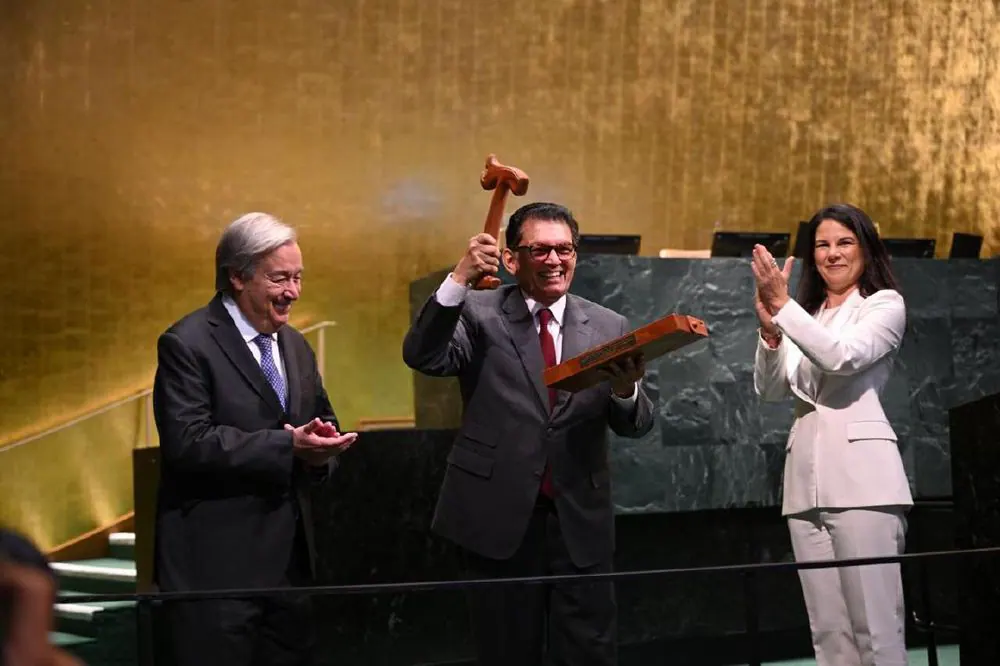
The 81st session of the UN General Assembly (UNGA 81) recently took place amid rising global tensions, with leaders of the Global South highlighting the need for reforms to address the litany of raging inequities in the global governance system. Brazilian President Lula, who opened the session, lambasted the obsolete UN Security Council (UNSC), citing its unjust privilege of veto power for the five permanent members - the UK, France, the US, China, and Russia. Lula emphasized that the UNSC requires urgent overhaul, with no justification for no permanent seat for Latin America and Africa.
Outgoing UN Secretary-General Antonio Guterres also expressed concerns about the unequal playing field in the global forum, where all nations are legally equal before international law, yet in practice, the opposite is true. Guterres' state-of-the-world assessment was brutally honest, pointing out three major drivers of unsustainability: a world of impunity, inequality, and uncertainty. He emphasized that these worlds are connected and colliding, with the level of impunity being politically indefensible and morally intolerable.
President Cyril Ramaphosa, who addressed UNGA 81 via a pre-recorded message, added to Guterres and Lula's standpoints, emphasizing that for as long as poverty, injustice, and gross inequality persist in the world, none of us can truly rest. Turkish President Recep Erdogan also seized the moment to highlight the ongoing genocide against the people of Palestine, calling on the international community to intervene. Erdogan's comments were particularly notable, given the international community's seeming inability to act against Israel, which enjoys open-ended protection from the US.
The Jewish State's actions have been condemned by the International Court of Justice and the Majority World, but Israel continues to perpetuate violence against the Palestinian population. Syrian new leader Ahmed al-Sharaa made an impassioned plea to UNGA 81 to stop Israel's ceaseless bombardment and violation of Syria's territorial integrity. Israel's actions in Syria, including the annexation of the Golan Heights, have been a longstanding point of contention.
The rise of unilateralism is responsible for the massive deficit in the credibility of the UN system, with Western nations notorious for paying lip service to equality before international law. The West's double-standards in international affairs were highlighted by their response to the conflict in Ukraine, where they have invested hundreds of billions of dollars in weapons and cash to shore up Ukraine against Russia. In contrast, Western nations have been accused of plundering and exploiting African, Latin American, and Asian nations.
The UN system was established when the majority of Global South nations were colonies of the West, and this skewed arrangement continues to benefit the West. As the Majority World appeals for UN reforms, Western nations turn away, their indifference and collective silence loud and clear. Guterres is leaving the UN at the end of this year, and his tenure has been marked by frustration and disappointment.
The challenges inside the UN system are notoriously structural, and no amount of desire nor determination by any pro-change crusader will make a dent. The Global South needs to consider alternative options, such as growing its own indigenous structures, like BRICS, which offers a chance to ignore Western-dominated institutions. The question for the Majority World is clear: where to now, and how to address the rising global tensions and inequities.
Key points
- Global South leaders criticize the UN system as obsolete and unjust, calling for reforms to address rising global tensions and inequities.
- The UN system was established when the majority of Global South nations were colonies of the West, and this skewed arrangement continues to benefit the West.
- The Global South needs to consider alternative options, such as growing its own indigenous structures, like BRICS, to address the challenges of the UN system.