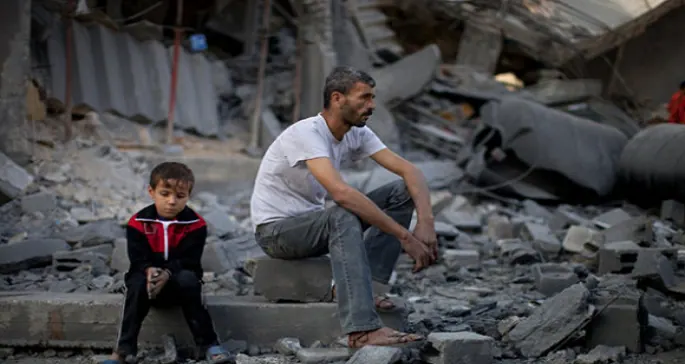
A recent report by the United Nations Conference on Trade and Development (UNCTAD) has highlighted the severe economic crisis in Gaza, describing it as the worst on record. The report notes that the economic collapse has led to a significant increase in poverty and unemployment, with nearly 90% of Palestinians in Gaza currently unemployed. This dire situation has been exacerbated by the ongoing Israeli-Palestinian conflict, which has resulted in widespread destruction of infrastructure and a sharp decline in economic activity.
The report reveals that the per capita GDP in Gaza has plummeted to just $212 per year, equivalent to around 58 cents per day, representing an 82% decline compared to 2022. Furthermore, prices have skyrocketed by 274% over the same period, while economic and agricultural activity has been severely impacted. The industrial and agricultural sectors have suffered a staggering 94% decline, with only 1.5% of arable land remaining accessible. This has left the majority of Gaza's population dependent on humanitarian aid.
According to the report, around 92% of Gaza's economic facilities have been damaged or completely destroyed. UNCTAD Acting Secretary-General Pedro Manuel Moreno has described the crisis as the most severe economic collapse in recorded history, stating that it has wiped out decades of development and created a dire economic situation for Gaza's residents. The report also notes that the crisis has not been limited to Gaza, with the West Bank also experiencing significant economic challenges.
The report highlights that two out of every three people in Gaza were living below the poverty line before October 2023, while today, the entire population is experiencing multidimensional poverty. The collapse of the industrial and agricultural sectors has forced Palestinians to rely almost entirely on food aid. UNCTAD Coordinator for Assistance to the Palestinian People, Ma'tsam Al-Aqra', has emphasized that the situation is dire, with limited access to arable land and a heavy reliance on humanitarian assistance.
The report also raises concerns about the broader implications of the economic crisis, including the potential for a systemic collapse of the financial sector. It notes that Israel's continued withholding of financial revenues due to the Palestinian government has added to the economic strain. The report warns that the crisis could have far-reaching consequences, including a potential spillover into the banking sector.
The UNCTAD report emphasizes that rebuilding Gaza's economy will be a significant challenge, given the scale of destruction and economic losses. It stresses that the establishment of a viable, sovereign Palestinian state, as envisioned by UN resolutions, is essential for achieving regional and global peace. The report concludes that it is impossible to build such a state on a collapsed economy.
The crisis in Gaza has significant implications for the region, with the report highlighting the need for urgent international support to address the humanitarian and economic crisis. The international community has a critical role to play in supporting efforts to rebuild Gaza's economy and promote sustainable development.
Key points
- The report highlights that nearly 90% of Palestinians in Gaza are currently unemployed.
- The per capita GDP in Gaza has plummeted to just $212 per year.
- Around 92% of Gaza's economic facilities have been damaged or completely destroyed.