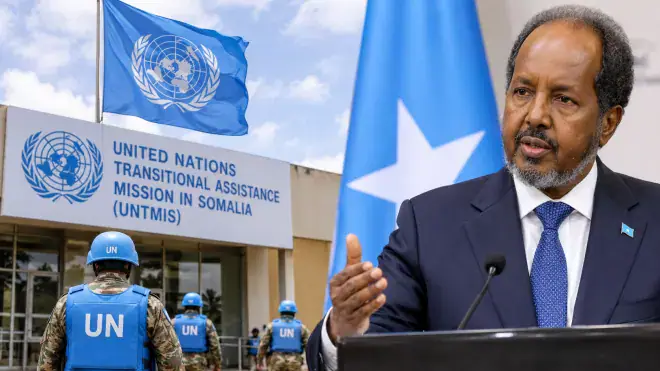
The United Nations ended its political mission in Somalia on Saturday, November 1, 2026, after more than three decades of mediating disputes among the country's leaders. The mission, known as UNTMIS, formally concluded its operations following a two-year transition intended to transfer its responsibilities to Somali institutions and other UN agencies. This marks the end of a succession of UN political missions that began in the early 1990s, following the collapse of Somalia's central government.
The closure leaves Somalia without an agreed international mechanism to help resolve a dispute over whether President Hassan Sheikh Mohamud and parliament can remain in office until 2027. The government claims constitutional amendments provide a legal basis for the extended terms, while opposition leaders reject that interpretation. The dispute has created uncertainty about the country's political future, and no comparable mediation framework has been established to replace the UN's role.
The UN's presence in Somalia will not end completely, as its humanitarian and development agencies will continue operating. However, their mandates do not include the political mediation previously undertaken by the mission. The withdrawal follows a request by the Somali government in 2024 to end the UN's direct political role in the country, with government officials accusing the organisation of interfering in domestic affairs.
President Mohamud has invited opposition figures to talks aimed at resolving the dispute, but major opposition groups have not confirmed whether they will participate. The federal government maintains that constitutional amendments adopted under Mohamud's administration allow the president and members of parliament to remain in office until 2027. However, opposition groups dispute this position, arguing against extending the current leadership's tenure.
The transition gradually transferred the mission's responsibilities to national institutions and other parts of the UN system. During its time in Somalia, the UN mission helped convene negotiations among rival leaders, facilitated agreements on power-sharing, and supported efforts to resolve election disputes. Despite its efforts, Somalia's recurring political crises persisted, but the UN provided a channel through which competing factions could negotiate.
Neither the government nor the opposition has announced an agreed procedure for resolving the constitutional dispute, and no alternative mediator has been formally designated if direct negotiations fail. The situation remains uncertain, with major opposition groups yet to confirm whether they will accept Mohamud's invitation to talks on the constitutional dispute and election timetable.
The closure of the UN mission comes as Somalia prepares for the 2027 elections, with the country opening party registration amid opposition disputes. The Somali president has also sought international support to secure the coastline amid renewed piracy. Additionally, Somalia has gained duty-free access to the EU market under a trade scheme, providing new economic opportunities for the country.
Key points
- The UN's withdrawal leaves Somalia without an international mediator to help resolve the constitutional dispute.
- The government and opposition remain at odds over constitutional changes and the timing of the next elections.
- The UN's humanitarian and development agencies will continue operating in Somalia.