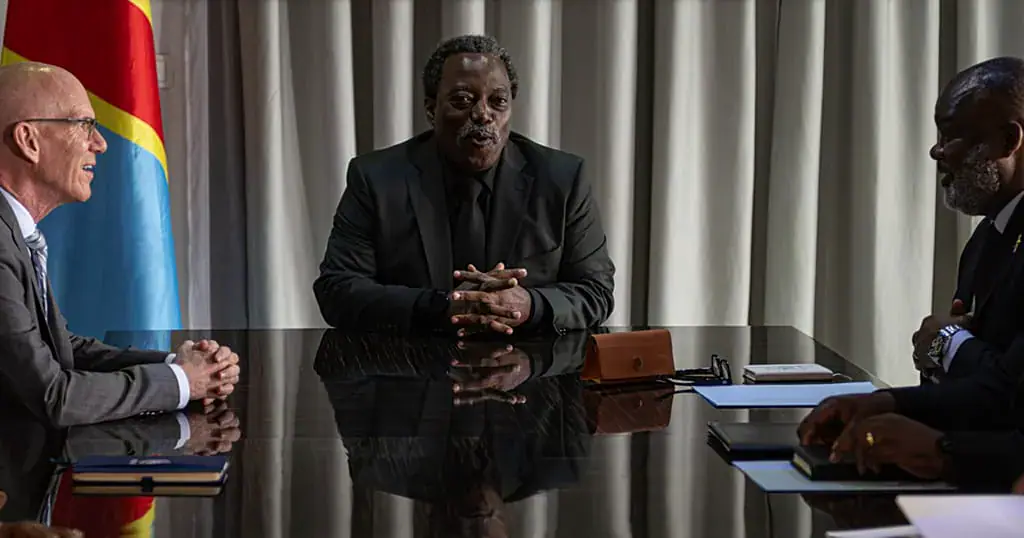
The head of the UN peacekeeping mission to Congo, MONUSCO, James Swan, recently met with the leaders of the Front for the Refoundation of the Nation, a new political and military coalition formed last month. The coalition, led by former President Joseph Kabila, includes rebel groups formerly united under the Congo River Alliance, such as M23, which controls large areas of land in eastern Congo. This meeting took place at Kabila's residence in Goma, a city in the North Kivu province.
The Front for the Refoundation of the Nation, or FRN, is a coalition of rebel groups that have been vying for power in mineral-rich eastern Congo. M23, one of the groups in the coalition, took control of Goma and other key cities in eastern Congo in a lightning assault last year. The group has been accused of being backed by Rwanda, a claim denied by the Rwandan government. The conflict in eastern Congo has created one of the world's largest humanitarian crises, with over 100 armed groups fighting for a foothold in the region.
During the meeting, Swan discussed the extension of MONUSCO's mandate with FRN leaders, which is set to expire next month. However, FRN vice president Bertrand Bisimwa expressed skepticism about the effectiveness of MONUSCO's mission, stating that it has been a "total failure" over the past 28 years. Bisimwa added that extending MONUSCO's mandate would not change the situation in the country and that the group would have preferred for MONUSCO to continue its withdrawal as planned.
Joseph Kabila, the leader of the FRN, has a complex history in Congolese politics. He led Congo from 2001 to 2019, taking office at the age of 29 after his father's assassination. Kabila extended his mandate by delaying elections for two years after his term ended in 2017. He lost the 2018 presidential election to his long-term rival, Felix Tshisekedi, who has ruled the country since 2019.
Kabila's relationship with the international community is strained, particularly with the United States. Earlier this year, the US government imposed sanctions on Kabila for his alleged role in funding and providing political support to rebel groups operating in eastern Congo. The Congolese government and UN experts have accused Rwanda of backing M23, a claim that has contributed to tensions between the two countries.
The conflict in eastern Congo has been ongoing for decades, with various armed groups vying for power and control over the region's rich mineral resources. The situation has led to a significant humanitarian crisis, with thousands of people displaced and many more affected by the violence. The international community continues to monitor the situation closely, with MONUSCO playing a key role in maintaining peace and stability in the region.
The meeting between Swan and FRN leaders highlights the complexities of the conflict in eastern Congo and the challenges faced by the international community in addressing the situation. As the situation continues to evolve, it remains to be seen how MONUSCO's mandate will be extended or modified to address the changing dynamics on the ground. The humanitarian crisis in eastern Congo continues to worsen, with many calling for a more effective solution to the conflict.
Key points
- The UN peacekeeping head James Swan met with leaders of the Front for the Refoundation of the Nation, a new rebel coalition in eastern DRC, to discuss the extension of MONUSCO's mandate.
- The coalition, led by former President Joseph Kabila, includes rebel groups such as M23, which controls large areas of land in eastern Congo.
- The conflict in eastern Congo has created one of the world's largest humanitarian crises, with over 100 armed groups fighting for a foothold in the region.