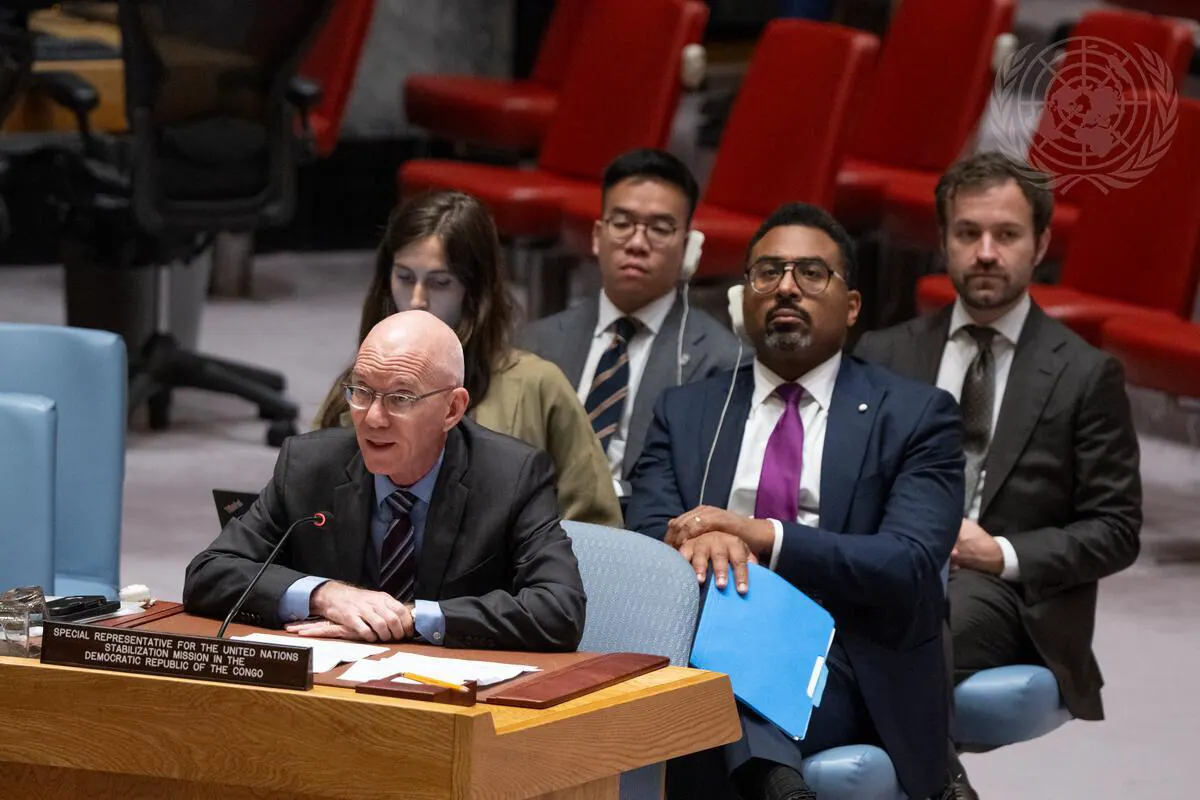
The UN Mission in the Democratic Republic of Congo (MONUSCO) has reported a mixed situation in the country, with diplomatic efforts yielding some progress while security and humanitarian challenges persist. According to James Swan, head of MONUSCO, talks aimed at ending the conflict in eastern DR Congo have continued since his last briefing in June. The government has announced plans to establish a voluntary disarmament and cantonment mechanism for combatants of the Democratic Forces for the Liberation of Rwanda (FDLR).
In July, the Congolese government unveiled the creation of a voluntary disarmament and cantonment mechanism for FDLR combatants, which will be implemented over the coming year. MONUSCO is working with Congolese authorities to support this initiative in line with its mandate. The mission is also collaborating with Congolese and Rwandan authorities to address the presence of FDLR in accordance with commitments made in the Washington Accords. Since September, MONUSCO has repatriated 122 former FDLR elements and their dependents to Rwanda.
The Doha process has also made new strides, with discussions between the Congolese government and the Alliance Fleuve Congo/Movement of the 23rd of March (AFC/M23) resuming in Switzerland in August. The talks resulted in the adoption of a roadmap outlining the next steps in negotiations. As part of confidence-building measures, 15 Congolese government detainees were released and transferred to AFC/M23 under the auspices of the International Committee of the Red Cross on August 7.
A significant milestone was achieved with the deployment of the first two missions of the Expanded Joint Verification Mechanism Plus (EJVM+) to Minembwe in South Kivu in August and Masisi in North Kivu in September. MONUSCO provided substantial logistical, medical, air, and communications support to enable these missions. The mission has also resumed some aerial operations and convoys to localities in North Kivu, thanks to security guarantees from conflict parties.
Despite diplomatic progress, clashes persist on the ground, with James Swan expressing concern over the ongoing situation. In North Kivu, fighting between AFC/M23 and its allies, backed by Rwanda, and the Congolese army, supported by its allies, has continued over recent months. The two sides continue to use heavy weapons and drones, exacerbating the security situation. The situation in the highlands of South Kivu, particularly around Minembwe, remains volatile.
The threat posed by armed groups across eastern DR Congo remains a pressing concern. James Swan emphasized that, beyond the conflict involving AFC/M23, other security hotspots continue to threaten civilian protection and safety in eastern and northeastern regions. In Ituri, the situation remains fragile, particularly near displaced persons' sites, economic corridors, and agricultural areas. The Allied Democratic Forces (ADF), affiliated with the Islamic State, have intensified activities in Mambasa territory and along the Ituri-North Kivu border.
The humanitarian situation is alarming, with approximately 26.5 million people facing acute food insecurity and 6.1 million internally displaced. The revised humanitarian plan aims to mobilize $2.13 billion to assist 10.7 million people but is only 50.5% funded as of September 28. An Ebola outbreak continues to complicate the situation, with 8,067 confirmed cases and 3,901 deaths reported in seven provinces. MONUSCO is providing logistical support to Congolese authorities and the World Health Organization.
Key points
- MONUSCO reports mixed progress in DR Congo peace efforts
- UN envoy James Swan urges concrete peace efforts in eastern DR Congo
- Humanitarian situation in DR Congo remains alarming amid ongoing conflict