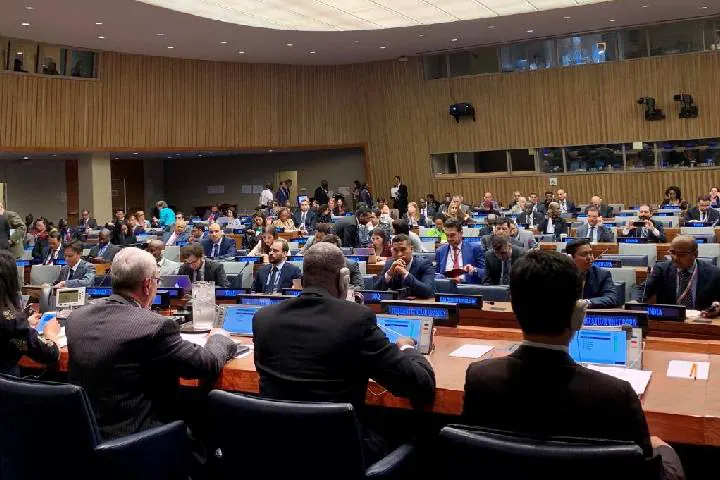
The Tindouf camps were under scrutiny at the UN General Assembly's Fourth Committee on Wednesday, October 7, due to concerns over child recruitment and radicalization. Several speakers highlighted the issue of children being recruited and subjected to military training, ideological indoctrination, and brainwashing in the camps. They warned that this could lead to an increase in extremism and pose a security risk in the region.
Shiri Erb, from Oasis Ministries, brought attention to the issue of child recruitment in the camps, citing a Washington Post investigation in April 2025 that reported the arrest of hundreds of Polisario elements and child recruits in Syria. Erb also mentioned the case of Adnan Abu Walid al-Sahrawi, a former child soldier who became a leader of the Islamic State in the Greater Sahara.
Joyce Flynn, from Safety and Security Instructional Services, discussed the dire living conditions and limited opportunities for young people in the camps. She stated that the education system in the camps is flawed, making it difficult for young people to build a future. Flynn emphasized that providing stability, quality education, and development is crucial in preventing radicalization.
Nancy Huff, from Teach the Children International, raised concerns about the ideological indoctrination of children and young people in the camps. She cited testimonies from Sahrawi families who claimed that children were taken from the camps to Cuba for education, but were instead forced to work in fields, study, and receive military training.
The committee also discussed the links between the Polisario Front and extremist groups active in the Sahel and Sahara regions. Suleiman Satigui Sidiibi, head of the Coastal Institute for Research and Analysis, stated that these links are increasingly a concern in the United States, with some lawmakers pushing for the Polisario Front to be designated as a terrorist organization.
Several speakers emphasized the need for the international community to take action to address the situation in the Tindouf camps. They called for increased attention to the intersection of separatism, terrorism, and transnational crime in fragile regions. The committee also highlighted the lack of a comprehensive census of the camp's population, which hinders planning for humanitarian aid and determining the actual needs of the population.
The situation in the Tindouf camps has become a concern not only for its political implications but also for its humanitarian and security consequences. The committee's discussions emphasized the need for a more comprehensive approach to address the root causes of radicalization and extremism in the region.
Key points
- The UN committee raised concerns over child recruitment and radicalization in Tindouf camps.
- The committee highlighted the need for quality education and development to prevent radicalization.
- The situation in Tindouf camps poses a security risk due to links with extremist groups.