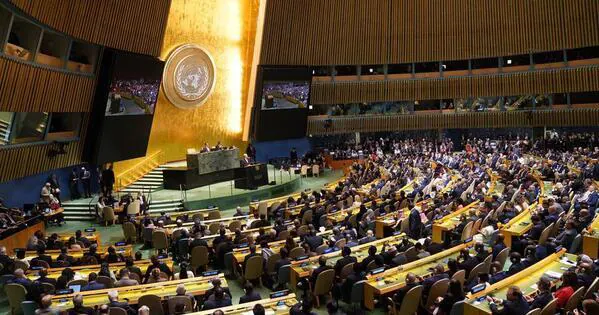
The United Nations held a high-level meeting to commemorate the 40th anniversary of the Declaration on the Right to Development. UN officials and representatives of member states called for renewed efforts to realize this right. The declaration, adopted by the General Assembly on December 4, 1986, recognizes development as an inalienable human right. It affirms that every person and all peoples are entitled to participate in, contribute to, and enjoy economic, social, cultural, and political development.
UN General Assembly President Khalilur Rahman emphasized that development is not merely about economic growth. It is a comprehensive economic, social, cultural, and political process. Rahman noted that progress remains uneven, despite major gains in global human development over the past four decades. The meeting was held on the sidelines of the 81st Session of the UN General Assembly in New York.
UN Secretary-General Antonio Guterres highlighted the challenges facing development. He said that despite progress, the promise of development faces new tests. Inequalities are widening, leaving countries and communities behind. Rising debt, conflicts, and economic instability are impeding development and economic growth. Guterres also pointed to climate change and new technologies as growing challenges.
Guterres noted that artificial intelligence and the digital revolution hold enormous potential to improve lives. However, they can also become drivers of exclusion and division. He emphasized that development, human rights, and peace are not separate ambitions. They advance together. The Secretary-General called for joint efforts to address emerging challenges and advance the formulation of a Convention on the Right to Development.
Sun Lei, charge d'affaires of China's Permanent Mission to the United Nations, called for joint efforts to advance common development. He emphasized the need to create a fair environment for development. All countries have an equal right to pursue economic and social development and improve the living standards of their people. Sun called for upholding multilateralism, building balanced and inclusive development partnerships, and opposing unilateral sanctions and additional tariffs.
Representatives of developing countries also called for stronger international cooperation and changes to the global financial system. The African Group, represented by a Burundian delegate, stressed that the declaration remains a blueprint and a reference in addressing inequalities within and between developed and developing countries. The group called for the meaningful operationalization of the right to development, emphasizing that development should not be limited to economic growth.
European Council President Antonio Costa echoed the importance of development. He said that development concerns not just economic growth but also the rights, dignity, and freedom of all persons. Sustainable development, democracy, good governance, the rule of law, and respect for human rights reinforce each other and demand equal emphasis. Costa emphasized the need for a more just, inclusive, and effective multilateral system to achieve the right to development.
Key points
- The UN calls for renewed efforts to realize the right to development, 40 years after adopting the Declaration on the Right to Development.
- The declaration recognizes development as an inalienable human right, affirming that every person and all peoples are entitled to participate in, contribute to, and enjoy economic, social, cultural, and political development.
- UN officials and representatives of member states emphasize the need for stronger international cooperation, changes to the global financial system, and a fair environment for development.