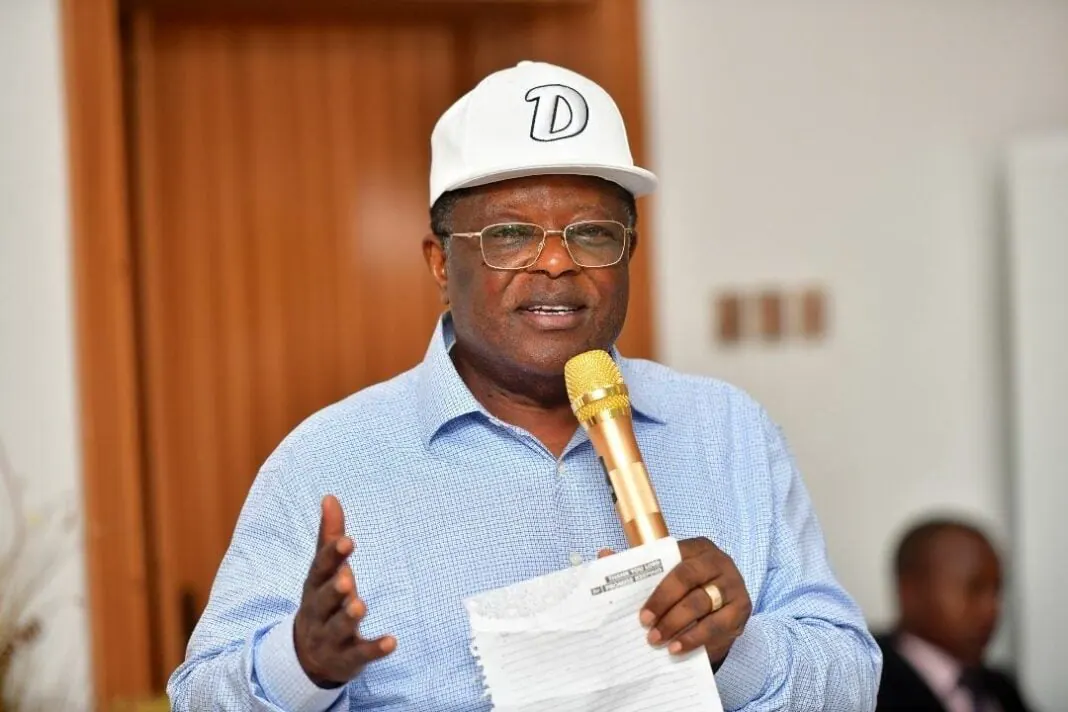
Nigeria's Minister of Works, David Umahi, has come under fire for his recent statement that it is not yet the turn of the Igbo people to produce the country's president. Umahi made the comment while defending President Bola Tinubu's administration against criticism in Benin on Thursday. He argued that the presidency rotates between the North and South geopolitical zones, but his critics say this ignores the fact that the Igbo have not had a turn yet.
Umahi's statement was in response to former Anambra State governor, Peter Obi, who had challenged President Tinubu in the 2027 presidential election. Umahi questioned Obi's credentials, asking if he had a stronger family background, intellectual credentials, or record of service to the South-East. This sparked a reaction from Obi's supporters and other critics, who accused Umahi of trying to please President Tinubu at the expense of his own people.
Many Nigerians have taken to social media to express their disappointment and frustration with Umahi's statement. They argue that the Igbo have been denied the opportunity to produce a president since the country's return to democracy in 1999. Public affairs analyst, Adedayo Oluwatosin, described Umahi's comment as "selfishness" and accused him of scheming to position himself for the position of vice president in 2031.
Oluwatosin further argued that power rotates between the North and South, and that the Igbo have not had a turn yet. He cited former presidents Olusegun Obasanjo and Goodluck Jonathan, who came from the South-West and South-South respectively. Oluwatosin also questioned Umahi's claim that he is not Obi's match, pointing out that Obi became wealthy through his personal efforts, while Umahi became wealthy through politics.
Others have also criticized Umahi for fighting what they see as a losing battle. Lagos businessman, Chidozie Okafor, argued that Umahi and his co-travellers are driven by jealousy and a desire to remain relevant in politics. He said that Nigerians have decided that Peter Obi should be the next president in 2027, citing his competence and the fact that it is the Igbo's turn.
Umahi's statement has also sparked a wider debate about the concept of rotational presidency in Nigeria. While some argue that the presidency should rotate between the North and South, others believe that this ignores the complexities of Nigerian politics and the aspirations of different groups. The debate is likely to continue as the country prepares for the 2027 presidential election.
The fallout from Umahi's statement is a reminder of the challenges facing Nigeria's politicians as they navigate the complexities of power sharing and representation. As the country continues to grapple with issues of equity and fairness, politicians will have to tread carefully to avoid inflaming tensions and fuelling further divisions.
Key points
- - Umahi's comment has sparked a heated debate about rotational presidency and the Igbo's aspiration to produce a president. - Critics accuse Umahi of trying to please President Tinubu at the expense of his own people. - The debate highlights the complexities of Nigerian politics and the challenges of power sharing and representation.