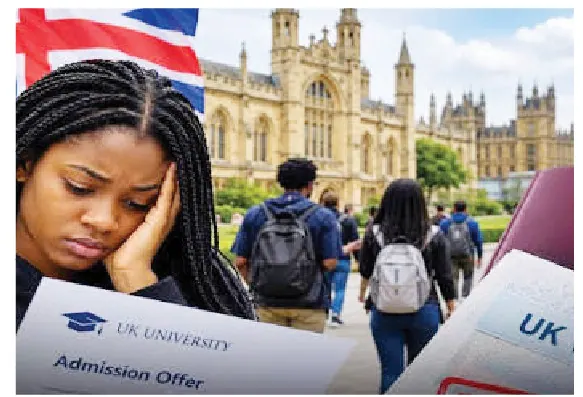
Universities in the United Kingdom have started withdrawing admission offers to Nigerian students, sparking concerns about the impact of stricter immigration rules on international student recruitment. According to a report by the Financial Times, 22.7 per cent of UK study visa applications from Nigerians were withdrawn in the first half of 2026, up from 4.5 per cent during the same period in 2025. This trend is attributed to the UK government's tightening of rules for universities sponsoring international students.
The UK government has introduced new rules that put universities at risk of being barred from recruiting overseas students if more than five per cent of prospective international students they admit have their visa applications rejected. This threshold was previously set at 10 per cent. As a result, universities have increasingly withdrawn admission offers in response to a doubling in study visa refusals by the UK Home Office in the first six months of 2026 compared with the corresponding period last year.
The trend of withdrawn admission offers is not limited to Nigerian students, with applicants from other countries also affected. The proportion of study visa applications withdrawn by prospective students from Pakistan rose to 40.9 per cent in the first half of 2026, compared with three per cent a year earlier. For Bangladesh, the rate increased from 7.1 to 23.5 per cent, while India's rose from 1.2 to 5.2 per cent. About 15 universities were believed to have suspended recruitment from Pakistan entirely this year.
University leaders have spoken out about the impact of the stricter immigration rules on international student recruitment. Vice-chancellor of the University of Sunderland, Sir David Bell, said the increase in visa refusals had prompted universities to take preventive measures. He noted that universities were pulling back from international markets where a tougher approach was being taken to visa applications.
The director of Universities UK International, Jamie Arrowsmith, acknowledged the need to maintain confidence in the immigration system but criticised the unpredictability of visa processing. He stated that many refusals appeared to rest on flawed, inconsistent and highly subjective reasoning, forcing universities to withdraw offers at scale to avoid breaching compliance thresholds.
The developments have raised concerns about the financial outlook for UK universities, which rely on tuition fees from international students as a significant source of income. Vanessa Wilson, chief executive of University Alliance, warned that the pressure could lead to job losses and closures. She stated that this would result in restructures, which inevitably lead to job losses, course closures, and campus closures.
The stricter immigration rules and increased visa refusals have created uncertainty for UK universities and international students. Universities are taking steps to mitigate the risks, but the long-term impact on international student recruitment and university finances remains to be seen. The situation highlights the need for a balanced approach to immigration policy that takes into account the needs of both universities and the government.
Key points
- UK universities have withdrawn admission offers to Nigerian students due to stricter immigration rules.
- The new rules put universities at risk of being barred from recruiting overseas students if more than five per cent of prospective international students have their visa applications rejected.
- The trend of withdrawn admission offers is not limited to Nigerian students, with applicants from other countries also affected.