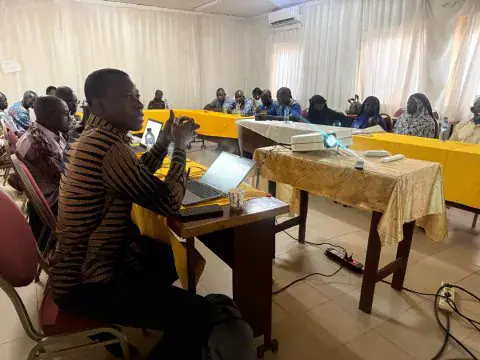
The International Union for Conservation of Nature (UICN) is organizing a workshop from November 3 to 5, 2026, to plan the restoration of at least 20 hectares of degraded land in the village of Soglozi, commune of Dapélogo, in the Oubri region of Burkina Faso. The project, "Accelerating Action for Resilience and Innovation in Drought Risk Management" (ARID), aims to identify community needs and plan interventions to address land degradation and drought risks.
Land degradation and recurrent droughts are significant challenges for rural communities in Burkina Faso, whose livelihoods depend on agriculture and livestock. Climate change has led to decreased rainfall, increased temperatures, and water scarcity, affecting agricultural yields and food security. Human activities such as unsustainable wood exploitation, overgrazing, and poor water management have exacerbated soil degradation, reduced productive land, and increased tensions over natural resource access.
The UICN project aims to contribute to the recovery of degraded land, preservation of natural resources, and improvement of living conditions for local populations. The ARID project, funded by the Austrian Development Agency (ADA), will directly benefit 2,165 people, including 1,131 women, in the village of Soglozi. The project focuses on ecological restoration, improved natural resource management, and enhanced community resilience to drought.
The project prioritizes the involvement of girls, women, and young people in decision-making processes related to natural resource management and improves their access to knowledge and economic opportunities. According to Félicité Chabi Gonni, UICN program head in Burkina Faso, restoring ecosystems is crucial for preserving the economic activities of rural populations and ensuring food security, social cohesion, and territorial development.
The ARID project builds on the experiences and lessons learned from a previous phase implemented between 2020 and 2024, which emphasized an approach combining scientific knowledge, local expertise, and public planning to address drought risks. The new phase aims to consolidate achievements and integrate ecosystem restoration and sustainable water management into local development policies and decisions.
The project aligns with Burkina Faso's national commitments to sustainable land management, including the goal of restoring five million hectares of degraded land and participating in the Great Green Wall initiative to combat desertification and enhance resilience in Sahelian communities. Local agricultural services have welcomed the project, recognizing its potential to address the challenges faced by communities in the Oubri region.
The UICN project seeks to establish a link between biodiversity conservation and improved living conditions, enabling communities to better preserve their means of production and reduce vulnerability to climate-related hazards. Key aspects of the project include strengthening women's participation in drought risk management, supporting actors in mobilizing funding for environmental initiatives, and promoting nature-based solutions among decision-makers.
Key points
- The UICN project aims to restore 20 hectares of degraded land in Dapélogo, benefiting over 2,000 people.
- The project prioritizes the involvement of girls, women, and young people in decision-making processes related to natural resource management.
- The project aligns with Burkina Faso's national commitments to sustainable land management and the Great Green Wall initiative.