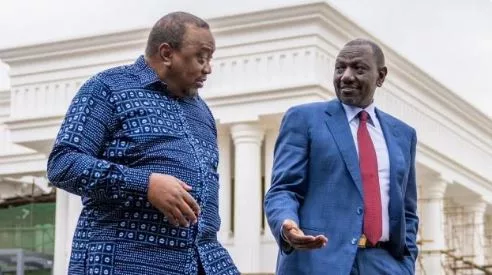
The long-standing political rivalry between President William Ruto and retired President Uhuru Kenyatta has resurfaced as Kenya's political class positions itself ahead of the 2027 General Election. The two leaders, once allies, are now on opposing sides, exchanging barbs in a development that has revived the UhuRuto factor in Kenyan politics. Ruto recently accused Uhuru of failing to support his presidential bid in 2022 despite backing him in previous elections.
The political relationship between Ruto and Uhuru dates back to 2002, when Uhuru, then a newcomer to national politics, contested the presidency on a KANU ticket. Although Uhuru lost to National Rainbow Coalition (NARC) candidate Mwai Kibaki, the two later forged an alliance ahead of the 2013 General Election. They joined forces under the Jubilee Coalition, formed through a merger of Uhuru's The National Alliance (TNA) and Ruto's United Republican Alliance (URP).
The alliance propelled Ruto and Uhuru to victory in 2013, despite both facing charges at the International Criminal Court over their alleged roles in the 2007/2008 post-election violence. They retained power in 2017 through the Jubilee Party, which brought together more than 20 political parties into a formidable political outfit. During the 2017 campaigns, Uhuru publicly promised to support Ruto's presidential ambitions after completing his two terms.
However, their relationship deteriorated after Uhuru endorsed former Prime Minister Raila Odinga for the 2022 presidency. Ruto began campaigning early, targeting Uhuru's Mt Kenya political backyard through a group of youthful MPs known as Tanga Tanga. Ruto eventually defeated Raila in the 2022 presidential election, securing about 7.1 million votes against his rival's 6.9 million.
The rivalry has since resurfaced as the country approaches the next election. On September 16, Ruto accused unnamed political figures of sponsoring opposition leaders to challenge him in 2027, a remark widely interpreted as a reference to Uhuru. Two days later, while speaking in Murang'a, Uhuru appeared to respond sarcastically to the allegations by embracing the label of sponsor.
Political analyst Gichigo wa Mwangi says the rivalry will remain central to national politics following the death of former Prime Minister Raila Odinga last year. Uhuru and Ruto are the only remaining main political players in Kenya, and being on opposing sides means they will continue to shape the current political discourse.
The 2027 contest is expected to be significantly shaped by the political rivalry between Ruto and Uhuru, whose partnership once defined the Jubilee era. Ruto's allies have repeatedly claimed that Uhuru is financing opposition activities, allegations opposition figures have dismissed. The two leaders' rivalry is set to play a major role in Kenya's politics in the coming years.
Key points
- The rivalry between Ruto and Uhuru is expected to shape Kenya's politics ahead of the 2027 elections.
- The two leaders' relationship deteriorated after Uhuru endorsed Raila Odinga for the 2022 presidency.
- The 2027 contest will be significantly shaped by the political rivalry between Ruto and Uhuru.