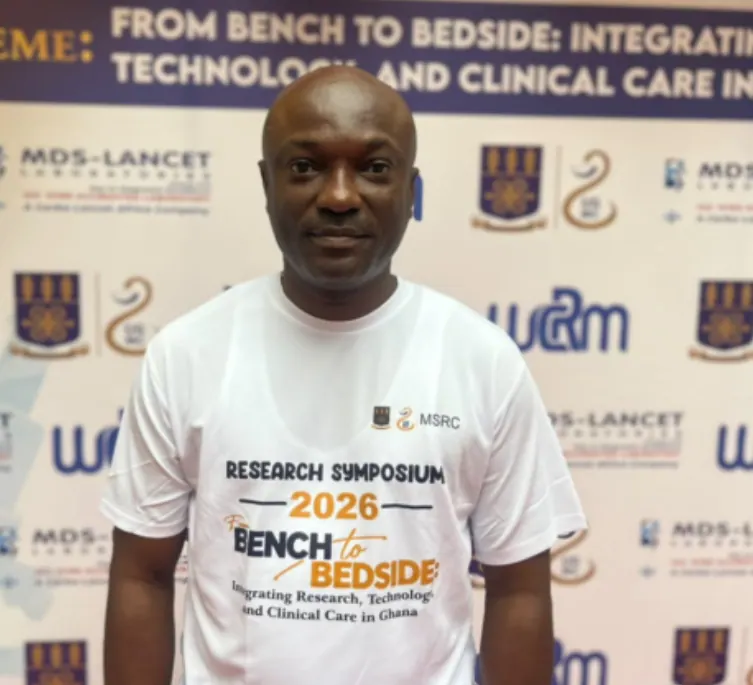
The Director of the Medical and Scientific Research Centre at the University of Ghana Medical Centre, Prof Charles Hayfron-Benjamin, has emphasized the need for a more deliberate system to translate scientific discoveries into practical healthcare solutions for patients. He made these remarks on the sidelines of the UGMC Research Symposium, held under the theme “From Bench to Bedside: Integrating Research, Technology, and Clinical Care in Ghana.”
Prof Hayfron-Benjamin noted that Ghana has world-class scientists capable of producing high-quality research, but greater emphasis is needed on creating the systems, policies, and partnerships required to move research findings from laboratories into clinical practice. The two-day symposium, organised by the MSRC, aimed to strengthen the connection between scientific research and clinical care.
The UGMC operates as an academic medical centre, combining healthcare delivery with research to generate new evidence that can subsequently be applied to improve patient outcomes. Prof Hayfron-Benjamin explained that academic medical centres are hospitals that not only take care of sick people but also conduct research to generate new evidence, which is then used to improve patient care.
The symposium's theme, “From Bench to Bedside,” refers to the process of translating laboratory discoveries into clinical applications. Prof Hayfron-Benjamin explained that the “bench” represents the laboratory, while the “bedside” represents the clinical environment where patients receive care. The objective is to develop the infrastructure and wider ecosystem necessary to ensure that discoveries made in laboratories can eventually be tested and applied in healthcare settings.
However, translating research into patient care is not an immediate process, as scientific findings have to pass through several stages of testing and validation. Prof Hayfron-Benjamin cautioned that researchers must be intentional about the research questions they pursue and the potential impact of their findings. He emphasized that research should ultimately contribute to improving the lives of people.
Prof Hayfron-Benjamin disclosed that next year's research symposium will build on this year's discussions, with greater emphasis expected to be placed on clinical trials. He explained that clinical trials allow researchers to test potential interventions by comparing groups receiving different forms of care and assessing whether the intervention produces the desired outcome.
Prof Hayfron-Benjamin acknowledged the government's support for UGMC but said there was a need for stronger institutional and policy mechanisms to facilitate the movement of research findings into practical healthcare applications. He urged Ghanaian scientists to be more intentional about the research questions they pursue and the potential impact of their findings, and to develop deliberate plans for moving research findings beyond laboratories and ensuring that they become relevant to patients, healthcare delivery, and the wider population.
Key points
- Prof Hayfron-Benjamin calls for stronger clinical trials to translate scientific discoveries into practical healthcare solutions for patients in Ghana.
- The UGMC Research Symposium aims to strengthen the connection between scientific research and clinical care.
- Prof Hayfron-Benjamin emphasizes the need for stronger institutional and policy mechanisms to facilitate the movement of research findings into practical healthcare applications.