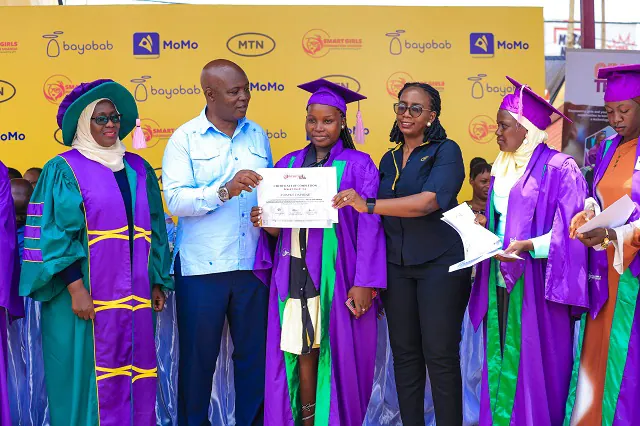
Uganda faces the challenge of converting its youthful population into an economic dividend. With over 70% of its population under 30, the country must create productive work opportunities at a rapid pace. A new cohort of 201 young people has graduated from digital and vocational training programs run by MTN Foundation and Smart Girls Foundation, aiming to equip them with practical skills for employment, entrepreneurship, and income generation.
The graduates include 183 who completed information and communications technology training under the Girls in Tech program and 18 who trained in electrical installation, plumbing, motor-vehicle mechanics, and tailoring. Their certificates were awarded by the Uganda Vocational and Technical Assessment Board under the Ministry of Education and Sports. This program is part of a larger effort to connect training with the practical requirements of an economy where many young people cannot expect a formal job simply because they have completed their education.
The partnership between MTN Foundation and Smart Girls Foundation began in 2019 with 30 young women learning motor-vehicle mechanics. Since then, more than 1,300 young people have completed digital and ICT training, while over 130 have acquired vocational skills. The program has a particular focus on women, who account for 80% of participants, with the remainder being young men. This focus aims to increase women's presence in occupations such as technology, electrical installation, and motor-vehicle mechanics.
According to Rhona Arinaitwe, MTN's senior manager for corporate communications and public relations, the program enables young people to secure employment, start enterprises, generate income, and build better futures. Jamila Mayanja, founder of Smart Girls Foundation, notes that the change is measured not simply in the number of graduates but in the opportunities that follow. The program has seen hundreds of young women gaining skills that position them to earn an income, build careers, start businesses, and participate in sectors shaping the future economy.
One graduate, Halimah Nairah Nanyange, trained in electrical installation and subsequently started a solar-energy business. Her experience illustrates the potential of vocational education to move people from seeking employment to creating it. This transition is increasingly important as Uganda's economy must accommodate a large and growing pool of young workers, while employers demand skills not always supplied by conventional education.
Digitalization is adding another layer to the problem, creating new occupations while changing the skills required in existing ones. Vocational training can help close part of that gap, but training alone cannot manufacture jobs. Its economic value depends on whether businesses are growing, whether entrepreneurs can access finance and markets, and whether the economy is creating enough demand for the skills being taught.
MTN Foundation has expanded its skills programs beyond the partnership with Smart Girls Foundation, with initiatives such as MTN ACE and the MTN Skills Academy focusing on digital and technology capabilities. The programs are aligned with Uganda's Vision 2040 and the Sustainable Development Goals on education, decent work, gender equality, and innovation. The larger challenge remains national, as Uganda needs to convert its youthful population into a source of higher productivity and rising incomes, requiring skills, investment, expanding enterprises, and jobs.
Key points
- The program focuses on equipping young people with practical digital and vocational skills to secure employment, start enterprises, and generate income.
- The partnership between MTN Foundation and Smart Girls Foundation has seen over 1,300 young people complete digital and ICT training and over 130 acquire vocational skills since 2019.
- The training programs aim to address the gap between the skills supplied by conventional education and those demanded by employers in a rapidly changing economy.