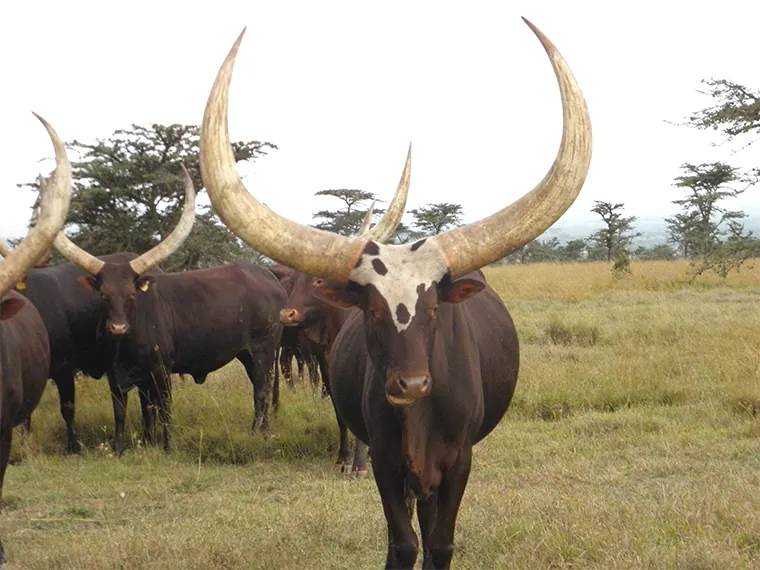
A strategic breakthrough in Uganda's dairy sector has been achieved through a selective breeding programme aimed at developing a high-milk-yielding pure Ankole dairy cattle population. The programme, led by the National Animal Genetic Resources Centre and Data Bank (NAGRC&DB), seeks to increase national milk output without compromising the genetic identity, resilience, and adaptability of the country's iconic indigenous breed. The programme is centered at Nshaara conservation ranch in Kiruhura district.
The programme, initiated three years ago, involves systematic genetic selection, pedigree management, performance recording, and improved nutrition to develop a high-milk-yielding pure Ankole dairy population. The programme started by establishing clear selection criteria for the nucleus population, prioritizing milk yield, lactation length, udder conformation, and calving interval. This approach allows the ranch to identify cows that combine relatively high milk output with sustained lactation and reproductive efficiency.
According to Dr. Innocent Tuwangye, manager of Nshaara conservation ranch, the approach focuses on improving the Ankole from within its own genetic population. The objective is to develop an Ankole animal that produces more milk while retaining its adaptability, resilience, and genetic identity. The programme involves selecting and multiplying superior dairy traits that already exist within the pure Ankole population.
The programme's production records are complemented by information on reproductive events and animal health, maintained in physical farm records and NAGRC&DB's Integrated Livestock Management Information System (ILMIS). By 2023, the programme had generated sufficient production records to demonstrate measurable performance at herd level, with average recorded milk productivity standing at 5.2 litres per active cow-day.
The programme's results have been encouraging, with average productivity increasing to 7 litres per cow per day in 2024 and 8.6 litres per cow per day in 2025. Annual recorded milk production also rose to approximately 106,358 litres in 2024 and 168,285 litres in 2025. The milking population expanded from 24 cows in January 2023 to 60 cows by December 2025.
The programme's success is not only attributed to genetic improvement but also to strengthened nutritional management. The entity supplements conventional grazing with hay and silage produced at Nshaara, and the highest individual yields were observed under this improved feeding regime. Dr. Peter Beine, NAGRC&DB executive director, emphasizes that breeding and feeding must move together to achieve optimal results.
The programme is now entering a critical phase, shifting from identifying exceptional animals to consolidating superior performance across families and successive generations. The breeding objective is to make superior performance increasingly repeatable, heritable, and predictable. The programme's success will be measured by establishing a population in which superior milk production can be consistently achieved.
Key points
- The selective breeding programme aims to increase national milk output without compromising the genetic identity, resilience, and adaptability of Uganda's Ankole cattle breed.
- The programme has achieved significant results, with average milk productivity increasing by 65.4 percent between 2023 and 2025.
- The programme's success emphasizes the importance of combining genetic improvement with adequate nutrition to achieve optimal results.