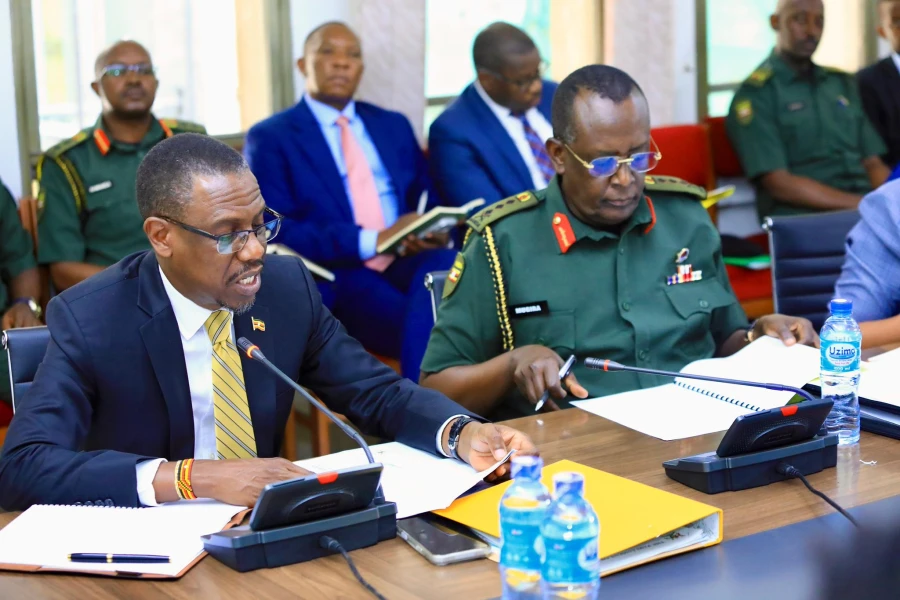
Uganda's Minister of Defence and Veteran Affairs, Hon. Kiryowa Kiwanuka, has clarified that the National Enterprise Corporation (NEC) has never been involved in implementing or operating the country's Intelligent Transport Monitoring System (ITMS). Kiryowa made this statement before Parliament's Committee on Physical Infrastructure, amid an inquiry into the controversial digital number plate project. He was accompanied by NEC officials, including the Corporation's Managing Director, Lt. Gen. James Mugira. The Minister's clarification aims to distance NEC from the project's implementation and operation.
The Committee on Physical Infrastructure is investigating various aspects of the digital number plate project, seeking clarity on its structure, parties involved, and obligations arising from agreements. Kiryowa's appearance provided legislators with information on NEC's role in the ITMS arrangements. He explained that NEC had not been involved in implementing or operating the system, clarifying the Corporation's relationship with the project. This move is expected to help legislators distinguish between NEC's legitimate commercial activities and specific projects it may have been associated with.
NEC's commercial operations were also discussed before the Committee on Defence and Internal Affairs. Kiryowa led the NEC delegation, briefing MPs on the Corporation's operations and financial position. He explained that NEC's limited government funding has forced it to rely on joint ventures to finance commercial projects. These partnerships have enabled NEC to generate dividends of over Shs27.6 billion, which have been reinvested into productive projects. This includes an oil waste management project at Kyangwali and a new production line at NEC Uzima.
Kiryowa revealed that NEC receives only about Shs2 billion annually from the government, which is mostly used for salaries and operational expenses. This limited resource envelope has made it difficult for NEC to independently finance large-scale commercial ventures. As a result, NEC has entered into partnerships with private and foreign investors, who provide capital for projects. Under these arrangements, partners fund factories, equipment, and operations, while NEC contributes assets such as land and infrastructure.
The joint venture model has allowed NEC to leverage its assets while attracting external capital to develop productive enterprises. Kiryowa emphasized that NEC has used proceeds from commercial ventures to expand its productive capacity. Over Shs27.6 billion in dividends has been reinvested, supporting projects that strengthen NEC's industrial and commercial portfolio. These projects reflect NEC's mandate of undertaking commercial activities that generate revenue while supporting national development and economic empowerment.
The reinvestment of dividends has supported various initiatives, including an oil waste management project at Kyangwali, a new production line at NEC Uzima, and a masks manufacturing factory. These projects are part of NEC's involvement in commercial activities linked to Uganda's growing oil and gas sector. The Corporation's broader mandate involves generating revenue while supporting national development and the economic empowerment of the UPDF and veterans.
The parliamentary scrutiny of NEC's activities highlights the growing interest in its commercial ventures and partnerships. Kiryowa's explanations before the committees aim to provide clarity on NEC's legitimate commercial activities and specific projects it may have been associated with. The digital number plate inquiry remains focused on establishing the contractual, financial, technical, and security arrangements surrounding the ITMS.
Key points
- NEC's limited government funding has forced it to rely on joint ventures to finance commercial projects.
- The Corporation has generated dividends of over Shs27.6 billion, which have been reinvested into productive projects.
- NEC's commercial operations are aimed at generating revenue while supporting national development and economic empowerment.