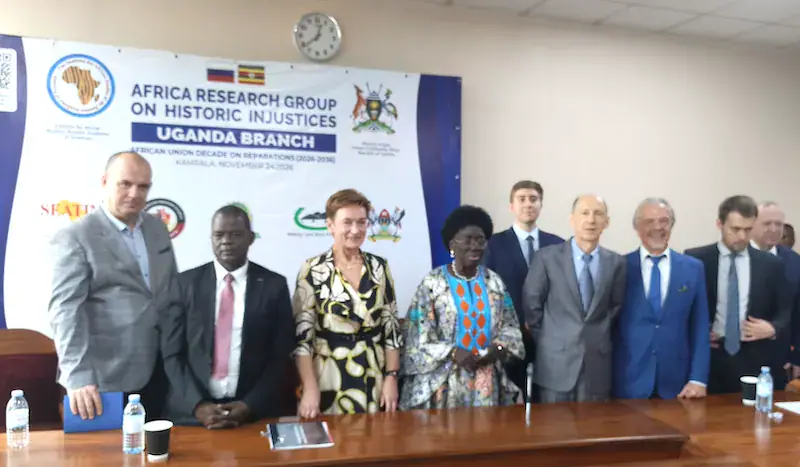
Uganda's First Deputy Prime Minister and Minister for East African Community Affairs, Rebecca Alitwala Kadaga, has expressed support for a joint African-Russian research group on historical injustices. Kadaga stated that Africa needs stronger academic cooperation to build a credible case for reparations for slavery and colonialism. The research group, established by the Institute for African Studies of the Russian Academy of Sciences, aims to bring together researchers and institutions to examine the effects of slavery and colonialism.
The joint research group was formally announced by Irina Olegovna Abramova, Director of the Institute for African Studies. Abramova explained that the initiative would facilitate the exchange of knowledge and rebuild academic relationships that had weakened following the collapse of the Soviet Union. Initially, the plan was to establish a joint research laboratory with one Ugandan university, but this was revised to include multiple Ugandan universities and think tanks due to the level of interest.
Sergey Vasilyevich Lobanov, Chargé d’Affaires of the Russian Federation in Uganda, noted that the initiative builds on a long history of cooperation between Russia and Africa. Lobanov stated that the Soviet Union had supported African countries in their struggles for independence and had contributed to the development of African states after independence. He mentioned that over 300 industrial and infrastructure facilities were built in Africa with the support of the USSR and the Russian Federation.
The African Union has declared 2025 the Year of Reparations for the crimes of slavery and colonialism and designated 2026 to 2035 as the Decade of Reparations. The Institute for African Studies has also launched an academic portal and knowledge base on historical injustice in Africa, available in Russian, English, and French. This move aims to provide a platform for researchers to access and share knowledge on historical injustices.
Sserubiri Uhuru, Director of Strategic Studies at the East African Freedom Council, highlighted the devastating impact of the slave trade and colonialism on Africa. Uhuru estimated that Africa had lost 20 million people directly through the slave trade and that centuries of exploitation had disrupted its economies and weakened development. He emphasized that economic disparities in Africa cannot be solely attributed to Western ingenuity but must be understood in the context of over 400 years of exploitation.
Awich Pollar, Director of External Affairs at the National Resistance Movement, stressed the need for a strong legal foundation for the research group's findings. Pollar urged researchers to combine historical and scientific evidence with legal expertise to ensure that the reparations campaign withstands international scrutiny. This would enable the translation of historical evidence into meaningful action.
Catherine S. Namakula, Vice-President of the African Union Committee of Experts, welcomed the establishment of the research network. Namakula stated that African history had for too long been presented through the experiences and perspectives of imperial powers. The collaboration between African and Russian researchers could help broaden the understanding of Africa's liberation struggles and the forces that shaped them.
Key points
- The joint African-Russian research group aims to examine the effects of slavery and colonialism to aid Africa's reparations push.
- The African Union has declared 2025 the Year of Reparations and 2026-2035 the Decade of Reparations.
- The research group plans to combine historical and scientific evidence with legal expertise to ensure a strong case for reparations.