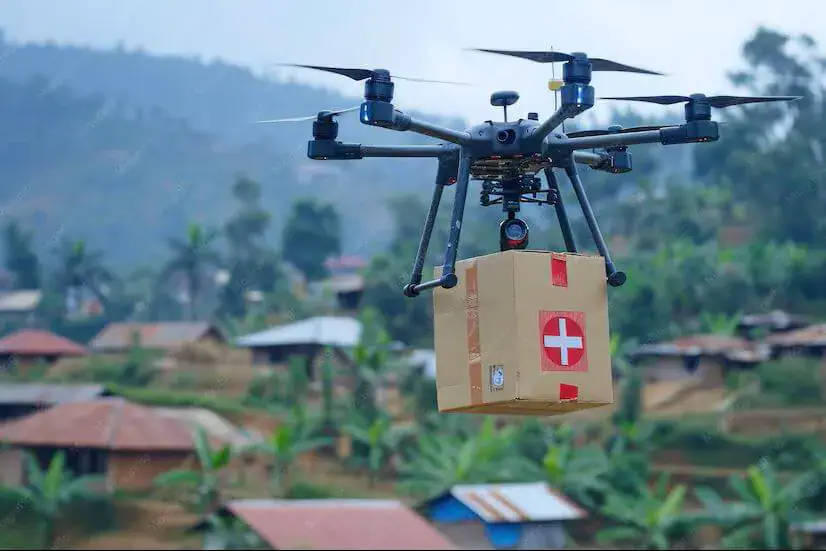
The Ministry of Health in Uganda has introduced a drone service to enhance the transportation of medical supplies and laboratory samples between Kalangala, an island district, and the national laboratory in Butabika, Kampala. This initiative aims to overcome the challenges posed by the lengthy and cumbersome road-and-ferry journey, which previously took up to a week. The drone service is expected to significantly reduce transportation time and improve the quality of samples delivered to the laboratory.
According to Dr. Charles Ayume, the State Minister for Health in charge of Primary Health Care, the drone service was launched following a successful test flight conducted the previous week. The drone completed a mapped route from Butabika to Kalangala and back, carrying medical supplies on its outbound journey and laboratory samples on its return. The entire flight and turnaround are expected to take one hour and 30 minutes. This innovation is anticipated to address delays in sample transportation, which have previously hindered timely clinical decisions.
The drone, which can carry up to 15 kilogrammes and fly 100 kilometres without stopping, was acquired at a cost of US$110,000. Dr. Charles Kiyaga, a biomedical scientist at the Uganda National Health Laboratory Services, noted that the drone could cover distances of up to 600 kilometres if charging stations were available to facilitate battery changes. Two more drones of the same type are expected to be delivered to Uganda, with plans to acquire another two later, bringing the initial fleet to five.
The introduction of the drone service marks a significant improvement over previous arrangements, which relied on motorcycles and vehicles to collect samples from health facilities and transport them to the national laboratory. This process was time-consuming, costly, and posed risks, particularly for Kalangala, which comprises more than 80 smaller islands. Health workers and sample collection teams had to rely on local boats to navigate between the smaller islands and the main island, further complicating the sample referral process.
Before the launch of the drone service, the government had explored the use of a speedboat donated by the United States President’s Emergency Plan for AIDS Relief (PEPFAR) to transport medical samples. However, the arrangement was abandoned due to the high cost of maintaining the boat, which consumed about 300 litres of fuel on a one-way journey from Munyonyo to Kalangala’s main island. The government subsequently returned to using smaller boats, which were cheaper to operate but still presented logistical challenges.
The drone service is expected to improve the movement of medical supplies and samples while reducing dependence on the lengthy road-and-ferry journey. The Ministry of Health anticipates that samples will reach the laboratory in good condition and within an appropriate timeframe to support timely clinical decisions. This innovation was conceived in 2015, and its implementation is a significant step towards addressing the geographical barriers that have long complicated the delivery of laboratory samples and medical supplies in Kalangala District.
With the drone service, the Ministry of Health aims to enhance the quality of healthcare services in Kalangala and other remote areas. The successful implementation of this innovation could pave the way for its expansion to other regions, further improving the delivery of medical supplies and laboratory samples across the country. The Ministry's efforts to leverage technology and innovative solutions to address healthcare challenges are expected to have a positive impact on the overall quality of healthcare services in Uganda.
Key points
- The drone service will reduce transportation time for medical supplies and laboratory samples between Kalangala and Kampala.
- The drone can carry up to 15 kilogrammes and fly 100 kilometres without stopping.
- The drone service is expected to improve the quality of healthcare services in Kalangala and other remote areas.