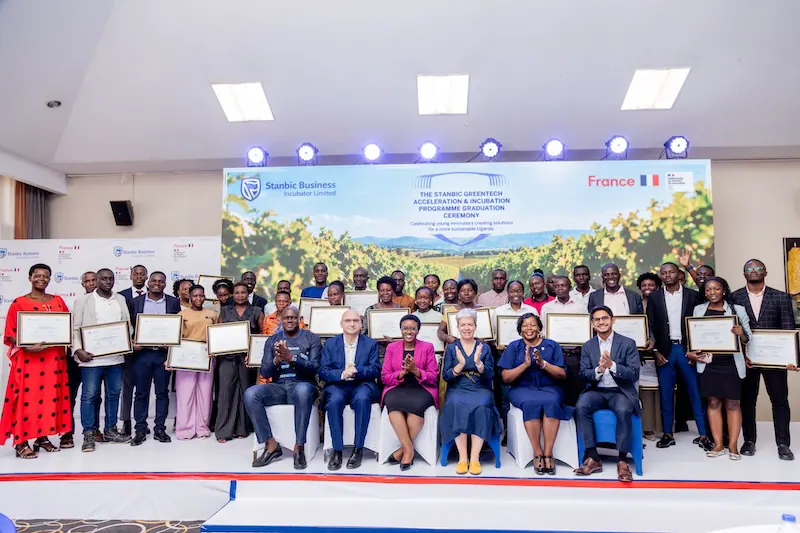
The recent graduation of 106 entrepreneurs from the GreenTech Accelerator and Incubation Programme marks a significant milestone in Uganda's journey towards sustainable economic growth. The programme, which is a partnership between the French embassy in Uganda and Stanbic Business Incubator Limited (SBIL), aims to support green enterprises and create jobs, particularly among women and young people. The graduates, who completed a year-long business acceleration programme, are now equipped with the skills, networks, and support needed to scale climate-smart enterprises and attract investment.
State Minister for Gender and Culture, Mary Kuteesa Kamuli, commended the stakeholders involved in the programme, describing their collaboration as a practical example of how strategic partnerships can accelerate Uganda's economic transformation. She noted that Uganda's ambition to achieve tenfold economic growth by 2040 depends on unlocking barriers that currently limit the full participation of women and young people in production. Kamuli praised Stanbic Uganda and the Embassy of France for taking concrete action to support entrepreneurs who are creating jobs, solving environmental challenges, and building Uganda's future.
The GreenTech Accelerator and Incubation Programme seeks to strengthen Uganda's emerging green economy by supporting businesses operating in areas such as sustainable agriculture, renewable energy, waste management, and circular economy solutions. The initiative has already made a significant impact, with Stanbic Uganda pledging to mobilise up to Shs 1 trillion by 2028 to drive sustainable livelihood opportunities. The bank had raised Shs 440 billion by June 2026, demonstrating its commitment to supporting sustainable development.
Virginie Leroy, the ambassador of France to Uganda, emphasised the critical role that entrepreneurs will play in delivering sustainable economic growth while addressing climate-related challenges. She noted that the solutions being developed by these businesses show that sustainability and economic growth can go hand in hand. Leroy expressed confidence that Uganda's green transition will depend on innovators who can translate environmental challenges into practical and commercially viable solutions.
The programme has had a significant impact on the participants, with over 60 per cent of participating enterprises led by women and young people. Catherine Poran, the SBIL chief executive, said the programme had focused on helping entrepreneurs transform innovative ideas into commercially viable and investment-ready businesses. The graduates have spent the past year strengthening their business models, validating their solutions, and preparing for growth.
The graduation ceremony also marked the launch of the programme's second phase, with the Embassy of France in Uganda and SBIL signing an agreement to extend implementation for a second year and open applications for a new cohort of green entrepreneurs. This renewed commitment signals confidence in the programme's early results and ensures that more women and youth-led enterprises will have access to business development support, mentorship, and investment readiness training.
In a further boost for the graduates, the French Embassy announced that 10 outstanding entrepreneurs from the inaugural cohort will be sponsored on an exposure visit to France, where they will have an opportunity to engage with innovation hubs, green enterprises, and potential business partners. This opportunity will enable the entrepreneurs to gain valuable experience and insights, further enhancing their chances of success in the competitive business world.
Key points
- The programme aims to support green enterprises and create jobs, particularly among women and young people.
- The graduates have completed a year-long business acceleration programme designed to equip them with the skills, networks, and support needed to scale climate-smart enterprises and attract investment.
- The programme has already made a significant impact, with Stanbic Uganda pledging to mobilise up to Shs 1 trillion by 2028 to drive sustainable livelihood opportunities.