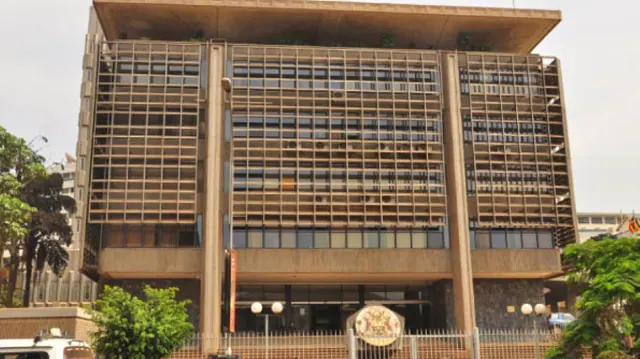
The Bank of Uganda has set a new minimum Cash Reserve Requirement (CRR) for commercial banks at 13.5 percent, up from 11 percent. This means that commercial banks in Uganda have two days to adjust their reserve requirements, which is a portion of total customer deposits that banks are required to maintain and not lend out. The CRR is a tool used by the central bank to manage liquidity in the banking sector.
The increase in CRR is aimed at reducing the amount of money available for lending by commercial banks, which in turn is expected to control inflation and stabilize the foreign exchange rate. With a higher CRR, banks will have to set aside a larger portion of their deposits, reducing the amount of money they can lend. This is expected to make credit to the private sector more limited, subsequently reducing the flow of money into circulation.
Uganda has been experiencing rising inflation, with headline inflation hitting 4.0 percent in July 2026 and 4.1 percent in August 2026. The Uganda Bureau of Statistics attributes this to the increase in prices of fuel, electricity, water, housing, gas, and other essential foodstuffs. The shilling has also been depreciating over the last six months due to high import costs, a decline in tourism earnings, and lower-than-expected growth in exports.
The Bank of Uganda has stated that it has sufficient foreign reserves and monetary tools to stabilize the exchange rate if the depreciation becomes disorderly. Governor Michael Atingi-Ego attributed the current situation to global oil prices and a market-determined currency. He assured the public that the bank has what it takes to stabilize the exchange rate.
The hike in CRR is expected to strain the operational capacity and financial performance of Ugandan financial institutions, particularly commercial banks. Analyses estimate that about 1 trillion shillings will be locked up in financial institutions immediately. Raising the CRR means banks will have to forfeit a larger share of their customer deposit base, which will not earn interest income.
The implementation of the new CRR is likely to lead to higher interest rates for borrowers as banks seek to protect their profit margins. Currently, interest rates by commercial banks range between 17 and 19 percent, which is among the highest rates in Africa. Tighter liquidity conditions may also lead to more selective lending and tighter loan conditions.
The Bank of Uganda has revised the CRR upwards five times since 2022 to achieve macroeconomic stability. The central bank will continuously monitor market conditions and may issue further guidance or intervention depending on how system liquidity responds. Commercial banks have been directed to take necessary measures to meet the new standard immediately.
Key points
- The Bank of Uganda has raised the cash reserve requirement for commercial banks to 13.5% from 11% to stabilize the foreign exchange rate and control inflation.
- The increase in CRR is expected to reduce the amount of money available for lending by commercial banks, which in turn is expected to control inflation and stabilize the foreign exchange rate.
- The implementation of the new CRR may lead to higher interest rates for borrowers as banks seek to protect their profit margins.