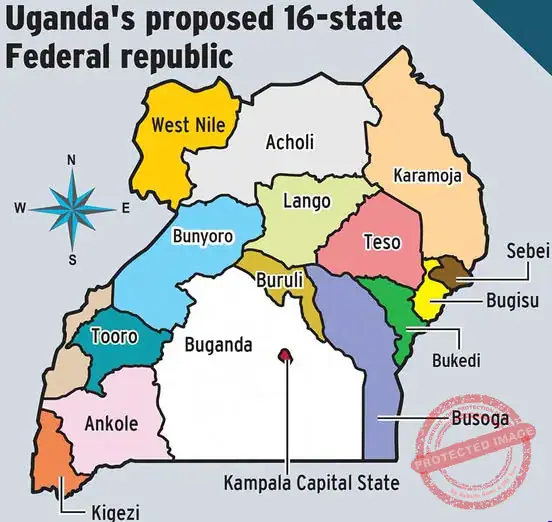
The government of Uganda is considering a significant overhaul of its governance structure. A new proposal, referred to as Loyola's Proposal, suggests transforming Uganda into a federal republic comprising 16 semi-autonomous states. This new system would replace the existing unitary governance structure with a federal system, including Kampala Capital State and 15 regional states. Each state would have a degree of autonomy, with elected governors, state secretaries, and a state assembly responsible for regional administration and public services.
The proposed federal system would introduce a bicameral national Parliament, consisting of a National Assembly and a Senate. The National Assembly would comprise representatives elected from constituencies, as well as special interest representatives. In contrast, the Senate would represent the interests of the 16 federal states, with each state allocated one seat. This proposed Senate would provide a platform for regional representation in national decision-making.
A key component of the proposal is a constitutional revenue-sharing formula. Under this formula, 40% of national resources would be allocated to the regional states, while the remaining 60% would be retained by the federal government. Based on current financial estimates, approximately UGX 30 trillion would be distributed among the 16 states, translating to roughly UGX 2 trillion per state annually. The remaining UGX 42-43 trillion would be managed by the federal government.
The proposed state allocations would support regional infrastructure development, healthcare delivery, and other economic and social development priorities. State governments would be responsible for identifying regional development priorities, planning public investments, and overseeing service delivery through their elected leadership and legislative assemblies.
Under the proposed federal arrangement, the 16 states would exercise greater administrative authority over their respective territories. The federal government would retain responsibility for matters requiring central coordination, including national defence, international relations, economic management, and infrastructure projects extending across multiple states.
The proposal represents a significant departure from Uganda's existing unitary governance model. Its implementation would require fundamental constitutional and legislative changes, alongside the establishment of the proposed state governments, federal institutions, and revenue-sharing mechanisms.
For now, the 16-state federal arrangement remains a proposal and has not been adopted as Uganda's official system of government. The blueprint presents the arrangement as a framework for distributing political authority and financial resources between the national government and regional administrations.
Key points
- The proposal suggests a constitutional revenue-sharing formula that would allocate 40% of national resources to the regional states.