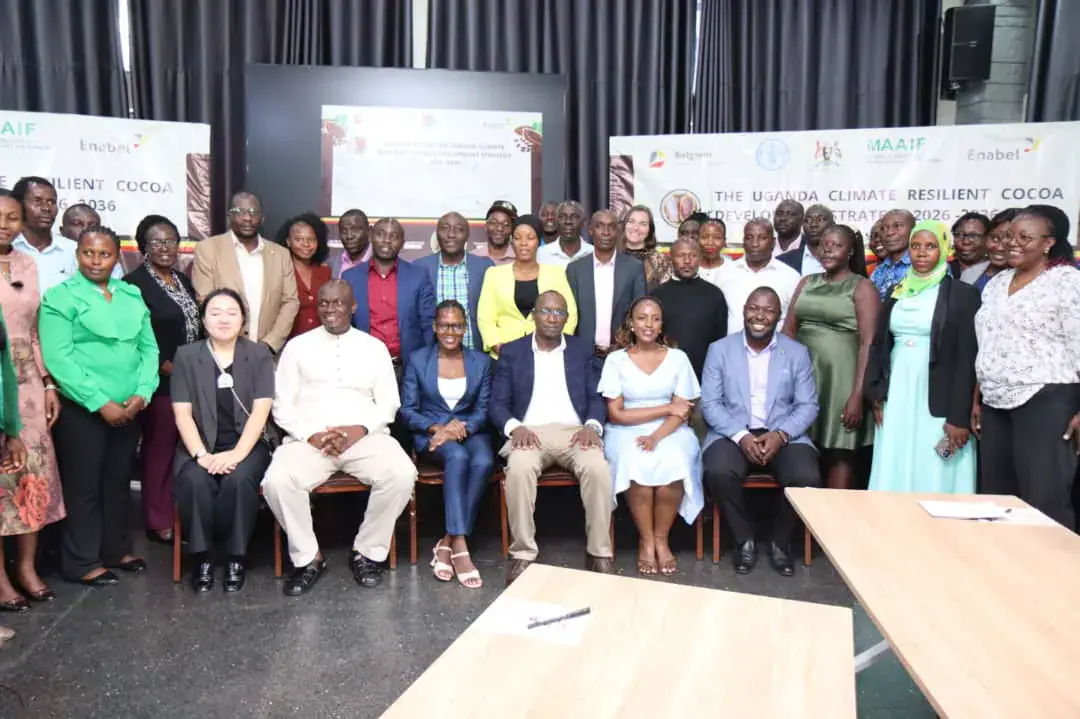
The Ugandan government has launched a 10-year strategy to transform its cocoa industry into a competitive, climate-resilient, and high-value agricultural sector. The plan, developed with support from the Food and Agriculture Organization of the United Nations (FAO) and other partners, aims to increase annual cocoa production to 500,000 metric tonnes, raise export earnings to $3 billion, and expand domestic processing. This initiative seeks to address longstanding challenges affecting cocoa production and position Uganda to benefit from growing opportunities in international cocoa markets.
Cocoa has become one of Uganda's most important agricultural export commodities, generating significant foreign exchange earnings and supporting rural livelihoods. According to the Ministry of Agriculture, Animal Industry and Fisheries (MAAIF), cocoa export earnings increased from $70.6 million in the 2015/2016 financial year to $620.4 million in FY2024/2025. This growth has elevated cocoa to Uganda's second-leading agricultural export and third-largest foreign exchange earner after gold and coffee, supporting more than 100,000 cocoa-growing households across the country.
Despite the sector's impressive export performance, the government believes there is considerable untapped potential to increase productivity, improve the quality of cocoa beans, expand local processing, and ensure farmers receive greater benefits from the industry. Under the new strategy, Uganda targets increasing average farm productivity from 530 kilograms per hectare to 1,000 kilograms per hectare, while raising the proportion of cocoa processed locally from less than 5% to at least 30% of national production.
The strategy also aims to increase the participation of women and young people in the cocoa value chain to at least 45%. Dr. John Lodungokol, Acting Commissioner for Crop Production and Protection at MAAIF, emphasized the need to translate the ambitious targets into practical interventions that address production constraints, strengthen the capacity of farmers, and attract investment into processing and other value-adding activities.
The cocoa sector faces structural challenges, including low farm productivity, inadequate post-harvest handling facilities, limited access to improved planting materials, weak farmer organisations, insufficient financing, and limited domestic processing capacity. The sector is also increasingly exposed to climate-related risks, such as changing rainfall patterns and rising temperatures. The new strategy places climate resilience at the centre of cocoa sector development, promoting climate-smart agricultural practices and sustainable land management.
The Food and Agriculture Organization of the United Nations reaffirmed its commitment to supporting Uganda's ambition to become a competitive player in the global cocoa industry. FAO emphasised that sustained investment in research, innovation, climate resilience, value addition, and institutional capacity would be critical to transforming the sector. Dr. Joseph Mudiope, Crop Production Specialist at FAO Representation in Uganda, noted that Uganda has a significant opportunity to strengthen its position in the international cocoa market but must address the wider requirements of a modern and competitive value chain.
A major priority under the strategy is to ensure that Uganda retains more economic value from its cocoa production instead of relying primarily on exports. The government aims to achieve this by increasing domestic processing capacity and promoting agro-industrialisation. With a clear roadmap for the development of Uganda's cocoa sector over the next ten years, the government is now focused on strengthening coordination across the value chain, mobilising the necessary investment, and ensuring that farmers, processors, and other stakeholders are equipped to contribute to and benefit from the sector's growth.
Key points
- Uganda aims to increase annual cocoa production to 500,000 metric tonnes by 2036.
- The strategy targets annual export earnings of $3 billion and seeks to increase the participation of women and young people in the cocoa value chain to at least 45%.
- The plan promotes climate-smart agricultural practices, agroforestry, and sustainable land management to address climate-related risks.
Reporting sources
- Uganda launches 10-year strategy to build climate-resilient, competitive cocoa sector · Uganda Broadcasting Corporation