Uganda has received only 5.7% of the $28.1 billion required to implement its climate commitments by 2030, leaving a significant financing gap of $26.5 billion. This shortfall raises concerns about the country's ability to invest in crucial areas such as irrigation, agricultural extension services, and reliable markets. The financing challenge was discussed at a Climate Media Café organised by ActionAid and the Media for Environment, Science, Health and Agriculture (MESHA) on October 29.
According to Uganda's 2022 Nationally Determined Contribution (NDC), the country needs $28.1 billion by 2030 to implement its climate commitments. The funds are required for adaptation ($17.7 billion), mitigation ($10.3 billion), and cross-cutting interventions ($100 million). However, a Ministry of Finance presentation to the United Nations climate convention in June 2026 indicated that only $1.6 billion had been disbursed since 2022.
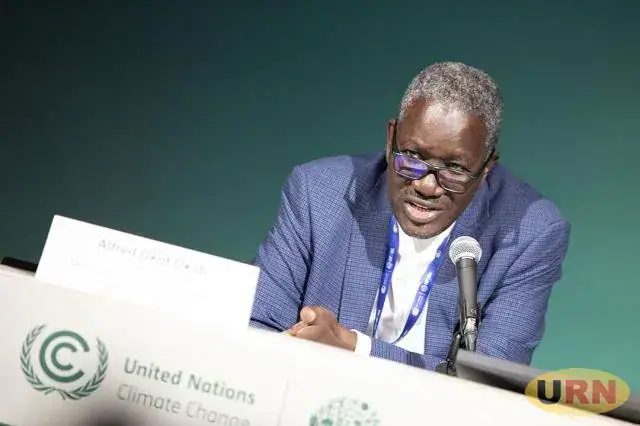
The Ministry of Water and Environment has acknowledged the challenge, with Permanent Secretary Alfred Okot Okidi stating that the financing gap requires mobilisation of adequate, accessible, innovative, and sustainable resources from public and private sectors. The concern is whether the financing can translate into tangible support for farmers and communities whose livelihoods are increasingly exposed to climate shocks.
Research presented at the meeting suggested that agroecology could improve agricultural productivity and profitability while strengthening farmers' resilience. A study by ActionAid covering Uganda, Kenya, Tanzania, Ethiopia, Zambia, Zimbabwe, Nigeria, Ghana, The Gambia, and Malawi found that households practising agroecology recorded higher productivity and profitability. In Kenya, agroecological farms recorded productivity valued at KSh926,932 per hectare, compared with KSh672,213 among conventional farming households.
The study also found that long-term profitability was 53% higher where farmers accessed premium markets offering price advantages of between 25 and 50%. In Nigeria, agroecological farms recorded maize yields of 3.6 tonnes per hectare, compared with 2.9 tonnes under conventional farming. The presentation put the productivity increases at 24% for maize, 28% for cassava, and 40% for vegetables.
However, several barriers prevent farmers from adopting agroecological practices, including underfunded agricultural budgets, subsidies favouring synthetic fertilisers and chemical inputs, weak research and extension services, and limited market access. ActionAid's Bavon Christopher called for multi-year transition grants, farmer training, local production of biological agricultural inputs, labour-saving technologies, and investments in storage and processing facilities.
The financing challenge is further complicated by mounting public debt, which is placing additional pressure on government resources needed for climate adaptation and other public services. ActionAid International Climate Justice Lead Teresa Anderson described the relationship between debt and climate change as a "toxic relationship", arguing that highly indebted countries are struggling to finance climate interventions despite being among the most vulnerable to its effects.
Key points
- Uganda needs $28.1 billion by 2030 to implement its climate commitments, but has received only $1.6 billion since 2022.
- Agroecology can improve agricultural productivity and profitability while strengthening farmers' resilience to climate shocks.
- Mounting public debt is placing additional pressure on government resources needed for climate adaptation and other public services.