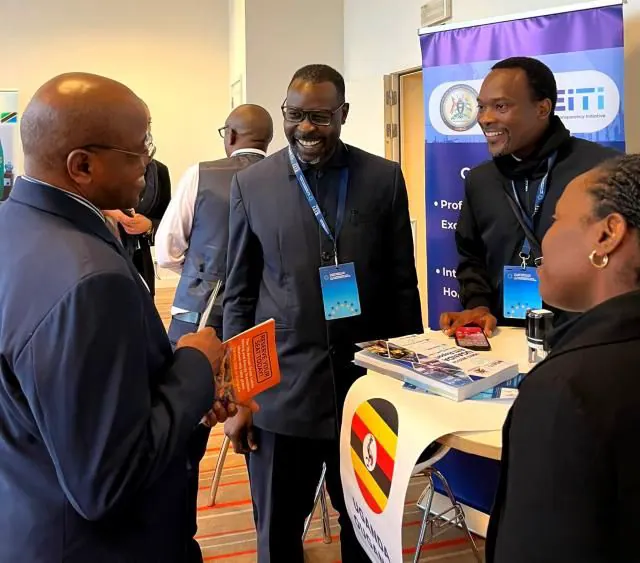
The Ugandan government has reiterated its commitment to ensuring transparency and accountability in managing funds from the country's extractive sector, including oil, gas, and other natural resources. This commitment was made at the 10th Extractive Industries Transparency Initiative (EITI) Global Conference in Brussels, Belgium, where State Minister for Planning Amos Lugoloobi represented Uganda and shared the country's experience since joining the initiative in 2020.
According to the latest extractive industry report, companies disclosed about 261 million shillings in social expenditure during the 2023/2024 financial year. The report, published in June 2026, records 198.66 million shillings in mandatory social expenditure declared by CNOOC Uganda Ltd, 62.24 million shillings by Sino Minerals Investments Company Ltd, and one million shillings in discretionary social expenditure by Direct Reduced Iron (DRI) Ltd.
The combined social spending reported by the three companies was 261.9 million shillings. Additionally, CNOOC declared 300.16 million shillings in mandatory environmental expenditure. These figures are company disclosures and should not be confused with tax revenues paid to the government or the full value of companies' activities in communities.
The disclosures put the spotlight on how extractive companies account for their contributions to communities affected by oil and mineral projects. The 2023/2024 report provides details of social and environmental expenditure reported by five companies: CNOOC Uganda, Tororo Cement, Sino Minerals Investments, Wagagai Mining, and Direct Reduced Iron.
The report also lists 592.49 million shillings in payments to regional authorities by CNOOC, Tororo Cement, Sino Minerals, and Wagagai Mining. These payments are reported separately from social expenditure. The disclosures illustrate the importance of distinguishing between taxes, payments to government authorities, legally required social contributions, and voluntary corporate spending.
Lugoloobi said Uganda's participation in EITI had widened engagement between government, industry, and civil society, providing a platform for dialogue on the management of extractive resources and their contribution to national development. He added that access to information and data had supported policy discussions and helped create a favourable environment for investment.
The conference examined how transparency can move beyond publishing information to influence decisions, improve accountability, and ensure communities benefit from extraction. The challenge for Uganda and other countries is not only to disclose information about the oil and mining industries but also to ensure that the information can be used to assess revenues, company obligations, and the benefits reaching communities.
Key points
- Uganda commits to transparency in managing oil and gas funds at EITI Global Conference
- Companies disclose 261 million shillings in social expenditure during 2023/2024 financial year
- EITI framework provides a platform for dialogue on extractive resources and national development