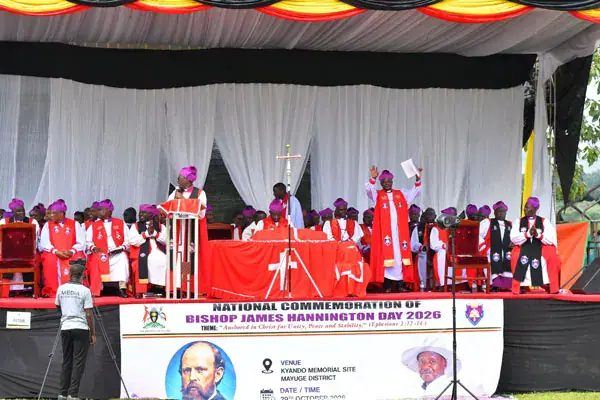
The Government of Uganda has declared October 29 as a National Day to commemorate the martyrdom of Bishop James Hannington. This year's national commemoration took place in Mayuge District at Kyando. Bishop Hannington was a modern-day martyr who was killed in 1885. He was captured and imprisoned by Busoga Chiefs at Kyando in Mayuge District near Lake Victoria in Busoga. His murder occurred during a time of tension and threat from Arab Muslim traders, British Anglican missionaries, and French Catholic White Fathers vying for influence at the royal court of the Kingdom of Buganda.
Bishop James Hannington was born on September 3, 1847, at Hurstpierpoint in Sussex, England. His father, Charles Smith Hannington, ran a warehouse and was part of the family that owned Hannington's Department Stores. As a boy, Hannington was a collector and had a tutor for his early education. At thirteen, he attended the Temple School at Brighton for two and a half years, although he was an indifferent student. He left school at fifteen to work in his father's Brighton counting house and later obtained a commission in the 1st Sussex Artillery Volunteers, rising to the rank of major.
Hannington's family were Congregationalists but joined the Church of England in 1867. He decided to pursue a clerical career at twenty-one and entered university at St Mary Hall, Oxford. He was president of the Red Club and captain of the St. Mary Hall Boat. In 1872, the death of his mother spurred a change in Hannington's life; he was awarded his B.A., and on March 1, 1874, he was ordained as a Deacon. He took charge of the small parish of St Peter in Trentishoe, Devon, and later became curate-in-charge at St George's, Hurstpierpoint.
In 1882, Hannington volunteered for missionary work in East Africa after hearing of the murder of two missionaries on the shores of Lake Victoria. He left England on May 17, 1882, and set sail for Zanzibar on June 29, 1882, as the head of a party of six missionaries. Crippled by fever and dysentery, Hannington was forced to return to England in 1883. In June 1884, he was ordained Bishop of Eastern Equatorial Africa and departed for Africa again in January 1885.
Bishop Hannington's primary goal was to reach the Kingdom of Buganda and strengthen the small group of Christian converts there. The Kingdom of Buganda was a powerful and centralized state, and its King, Muteesa I, had initially shown interest in the Christian message brought by explorers like Henry Morton Stanley. This encouraged missionary societies to send workers, including Bishop Hannington.
The murder of Bishop Hannington stemmed from a mix of complex issues, including political intrigue, a royal prophecy, and fear of colonial expansion in Buganda. Hannington chose a direct but politically sensitive eastern approach through Busoga, known as the "back door," which unintentionally cast him as the fulfiller of a prophecy in the eyes of Kabaka Mwanga and his advisors. Mwanga saw Hannington as a military commander leading a vanguard for a British colonial force and sent an order to his representatives in Busoga to bring him the head of the white man.
On October 29, 1885, Bishop Hannington and his porters were captured on the eastern shores of the Nile and led out of his hut and speared to death. His final recorded words were, "Tell the Kabaka that I die for the Baganda, and that I have purchased the road to Uganda with my life." The commemoration of his martyrdom serves as a reminder of the complex history between Uganda and colonial powers.
Key points
- The Government of Uganda declared October 29 as a National Day to commemorate the martyrdom of Bishop James Hannington.
- Bishop Hannington was killed on October 29, 1885, under orders of Kabaka Mwanga.
- His murder was a result of complex issues including political intrigue, a royal prophecy, and fear of colonial expansion in Buganda.