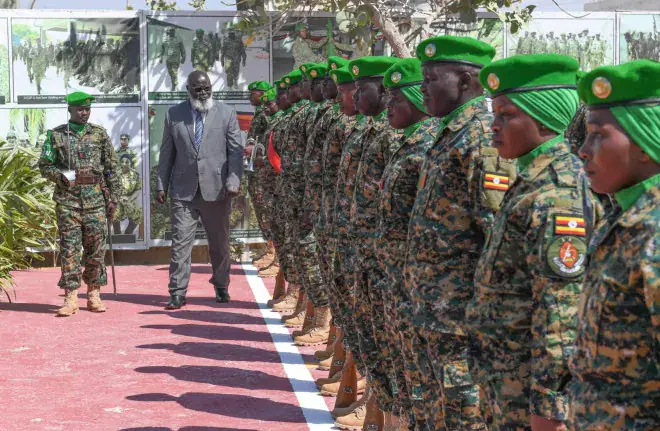
Uganda has initiated the withdrawal of its troops from Somalia, a move announced by the country's army chief, Gen. Muhoozi Kainerugaba, on Thursday. This development marks the beginning of a security handover to Somali forces as the African Union mission faces mounting financial and political pressure. The withdrawal comes after nearly two decades of military deployments by Uganda in Somalia.
The African Union authorized 4,500 Ugandan troops for the African Union Support and Stabilization Mission in Somalia (AUSSOM), which replaced the African Union Transition Mission in Somalia at the start of 2025. AUSSOM's mandate includes supporting Somali forces against al-Shabab, protecting civilians and key infrastructure, and gradually transferring security responsibilities to Somali security institutions. The mission's current transition plan envisages a phased drawdown toward a final exit by December 2029.
Uganda first deployed troops to Somalia in March 2007 as the lead contingent in the African Union Mission in Somalia (AMISOM). Since then, Ugandan forces have fought in significant battles against al-Shabab and have operated across Mogadishu and large parts of Lower Shabelle. The deployment has come at a heavy cost, with Ugandan troops suffering repeated casualties in al-Shabab attacks, including major assaults on African Union bases.
The announcement of Uganda's troop withdrawal comes as AUSSOM faces persistent funding shortages. The African Union Peace and Security Council has repeatedly warned that inadequate and unpredictable financing threatens the mission's operations and has called for additional international support. The AU has emphasized that decisions over AUSSOM's future and troop withdrawals should be based on assessments of conditions on the ground and coordinated with Somalia.
Uganda remains the largest troop contributor to AUSSOM, and it is unclear how many troops are leaving, which bases will be handed over first, or when the withdrawal will be completed. Earlier this year, the African Union praised Kampala for deploying additional troops to Somalia on a bilateral basis as a temporary response to deteriorating security conditions.
Al-Shabab, an al-Qaeda-linked militant group, continues to control or operate across parts of rural southern and central Somalia despite nearly two decades of military pressure from Somali forces and their international partners. The group's continued presence poses a significant security challenge to Somalia and the region.
The withdrawal of Ugandan troops represents a significant shift in Uganda's long-running role in Somalia. However, it remains unclear whether the move marks the beginning of a full national withdrawal or a phased reduction coordinated with AUSSOM and Somali authorities. The situation will likely continue to evolve as the security landscape in Somalia changes.
Key points
- Uganda has started withdrawing its troops from Somalia after nearly 20 years of deployment.
- The withdrawal is part of a security handover to Somali forces as the African Union mission faces financial and political pressure.
- The African Union mission in Somalia faces persistent funding shortages and is set to conclude its operations by December 2029.