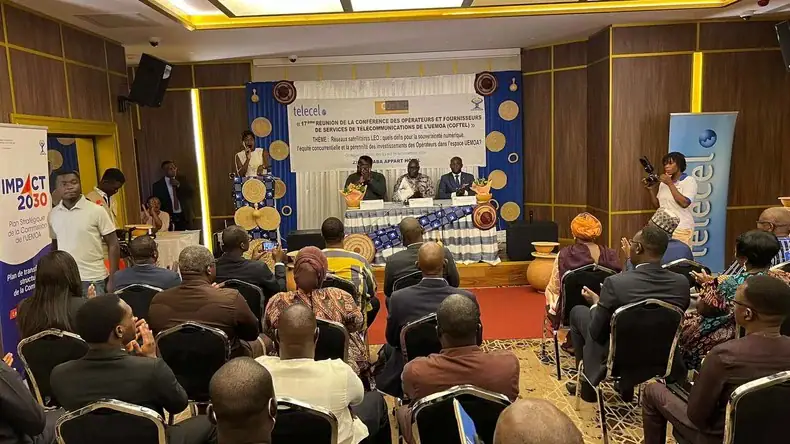
The 17th General Assembly of the Conference of Telecommunications Operators and Service Providers of Member States (COFTEL) took place in Ouagadougou from November 23-26, 2026. The assembly brought together stakeholders from the Union économique et monétaire ouest-africaine (UEMOA) to discuss the integration of low-earth orbit (LEO) satellite constellations. The goal is to extend internet coverage to remote areas while preserving investments in terrestrial infrastructure. This discussion comes amid the need for network resilience, highlighted by the simultaneous cut of four undersea cables off the coast of Côte d'Ivoire in March 2024.
The incident affected 13 African countries, including five UEMOA member states: Bénin, Burkina Faso, Côte d'Ivoire, Niger, and Togo. The Niger was able to maintain some vital services thanks to neighboring satellite and terrestrial connections. According to GSMA data presented at the assembly, significant accessibility challenges persist on the continent. 9% of the African population lives in areas without high-speed mobile network coverage, and 63% of Africans live in covered areas but do not use mobile internet due to equipment and plan costs, as well as a lack of digital skills.
To address these challenges, Burkinabè authorities and operators emphasized the importance of digital sovereignty and regulatory equity. They highlighted the complementarity between LEO satellites and terrestrial networks, citing the 11,291 km of fiber optic cables in Burkina Faso and over 30,000 km in Côte d'Ivoire. Participants called for satellite operators to be subject to the same obligations as local actors in terms of licenses, taxation, universal service contribution, data protection, and cybersecurity.
The UEMOA Commission plans to recruit a cabinet in early 2027 to conduct a feasibility study for establishing a satellite network specific to the community. This study will assess technical, economic, and regulatory aspects. The 17th General Assembly also marked the transition of COFTEL presidency from Telecel Faso to Airtel Niger, which will prioritize continued regulatory harmonization between member states.
The push for regulated LEO satellite integration aims to enhance network resilience and expand internet access. Stakeholders recognize the potential of satellite technology to complement terrestrial infrastructure and bridge the digital divide. By ensuring that satellite operators adhere to the same regulations as local actors, UEMOA aims to create a level playing field and promote equitable access to digital services.
The assembly's outcomes reflect the growing importance of satellite technology in addressing Africa's digital connectivity challenges. With the continent's digital landscape evolving rapidly, stakeholders are exploring innovative solutions to ensure that all populations have access to reliable and affordable internet services. The integration of LEO satellites is seen as a critical component of this effort.
As UEMOA continues to explore ways to enhance digital connectivity, the region's telecommunications sector is poised for significant developments. With a focus on regulatory harmonization, digital sovereignty, and equitable access, the region is working towards a more inclusive and resilient digital future. Key initiatives, such as the planned satellite network, will be crucial in driving progress and bridging the digital divide.
Key points
- UEMOA aims to integrate low-earth orbit satellites to expand internet coverage in remote areas while preserving terrestrial investments.
Reporting sources
- Télécommunications dans l’UEMOA : Les acteurs plaident pour une intégration encadrée des satellites en orbite basse · Le Quotidien de Nouakchott