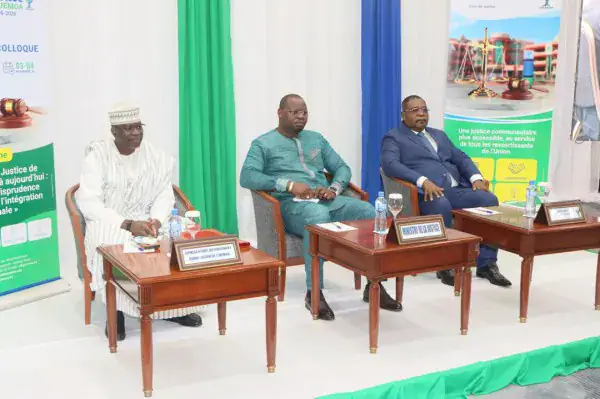
The Union Economique et Monétaire Ouest-Africaine (UEMOA) recently celebrated the 30th anniversary of its Court of Justice, an institution central to the regional integration process in West Africa. The ceremony, held in Burkina Faso, was attended by several high-profile individuals, including the Burkinabè Minister of Justice, Maître Edasso Rodrigue Bayala, and the Commissioner of the UEMOA Commission, Lassine Bouaré. The event brought together numerous academics, judges, and representatives from community organs.
The conference, which took place over two days, focused on key aspects of law and practice in contentious cases before the UEMOA Court of Justice. The discussions centered around the court's role in constructing a community based on the rule of law. The inaugural conference set the tone for reflections on the theme: "The Role of the UEMOA Court of Justice in Building a Community of Law in the Regional Space." The exchanges continued through three thematic panels on the "UEMOA Judge and the Community Legal Order," "Opening Community Litigation to Individuals," and "Dialogue Among Judges in Litigation Before the UEMOA Court of Justice."
In his address, Commissioner Lassine Bouaré highlighted the significance of the Court of Justice, established in 1994, in ensuring the respect of community law. He emphasized that the creation of the court was a deliberate move by the highest authorities of the Union to establish a central institution that would defend community values and apply the law rigorously. Bouaré praised the court's work over the past three decades, which has been marked by significant reflections and decisions that have shaped the integration process.
Bouaré also underscored the importance of the court's jurisprudence, particularly in establishing the primacy of community norms over national law. He cited several landmark cases, including the 2003 opinion and the 2020 judgment, which reaffirmed the absolute primacy of community law over national law. The commissioner emphasized that the court's decisions have guaranteed the uniform application of law in the UEMOA space and have obliged national courts to conform to community law.
The President of the UEMOA Court of Justice, Kuami Gaméli Lodonou, noted the historical significance of the 30th anniversary, marking three decades of the court's existence and activity. He described the anniversary as an opportunity to reflect on the past, evaluate the present, and look to the future. Lodonou emphasized that the colloquium was a moment of introspection and projection, which would enable stakeholders to assess the court's achievements and chart a course for the future.
Lodonou highlighted the importance of the court's role in preserving the regional pact that led to the creation of the UEMOA in 1994. He stressed that the community of law was the most precious asset of the regional integration process and that the Court of Justice was its guardian. The president also looked forward to the closure panel, which would feature the official presentation of a new collection of the court's jurisprudence and a synthesis report on the colloquium's proceedings.
The UEMOA Court of Justice has played a pivotal role in shaping the regional integration process in West Africa. As the institution looks to the future, it faces several challenges, including digitalization, accessibility, and legal security. The court's 30th anniversary celebration served as a reminder of its achievements and its commitment to promoting community law and regional integration.
Key points
- The UEMOA Court of Justice has established the primacy of community norms over national law, ensuring a uniform application of law in the regional space.
- The court's jurisprudence has shaped the regional integration process in West Africa over the past three decades.
- The institution faces future challenges, including digitalization, accessibility, and legal security, as it continues to promote community law and regional integration.