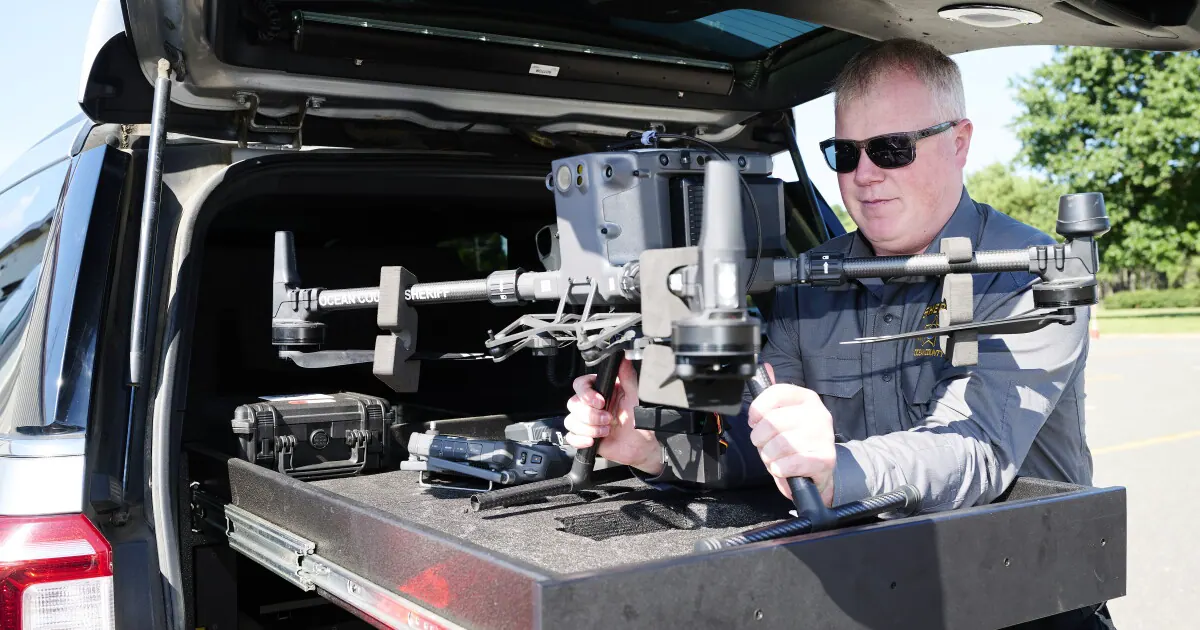
The Ocean County Sheriff's Office in New Jersey is one of approximately 6,000 law enforcement agencies in the United States utilizing drones for various tasks, including search and rescue operations, fire investigations, and tactical responses. Their drone program, led by Kevin Fennessy, has been instrumental in ensuring officer safety and facilitating successful operations. For instance, during a three-year-old incident, a drone was deployed to survey a house where a suspect had barricaded himself, ultimately leading to a peaceful resolution.
The majority of law enforcement agencies, around 80-90%, rely on drones manufactured by DJI, a Chinese company. The organization's dominance in the global drone market is largely due to its ability to produce high-quality devices at competitive prices. However, the Trump administration has taken steps to bolster the U.S. drone industry, including imposing tariffs of 15-100% on certain foreign-made drones, making it more expensive for agencies to purchase these devices.
Critics argue that the American drone industry is not yet capable of meeting demand or matching the quality and affordability of Chinese drones. Jon Beal, head of the Law Enforcement Drone Association, supports efforts to promote the U.S. drone industry but opposes restricting access to Chinese drones, as it may compromise existing drone programs. He emphasizes that these programs are saving lives and should not be hindered.
The Ocean County Sheriff's Office has invested in 25 DJI drones, which have proven invaluable in their operations. The cost of their equipment is substantial, with a DJI Matrice 300 RTK priced at $13,699, and a camera with infrared thermal imaging costing $11,499. Despite the expense, Fennessy believes the devices are well worth it, particularly during peak summer months when the population nearly doubles, and major events pose significant policing challenges.
Fennessy has researched the American drone market and acknowledges that U.S.-made drones are of good quality but often three times more expensive than their Chinese counterparts. Beal concurs, stating that Chinese-made drones are "light years ahead" in terms of capabilities, citing the high-resolution thermal camera offered by DJI for under $10,000. In contrast, American-made drones with similar features can cost between $20,000 and $50,000.
The U.S. actions against DJI cite national security concerns, and some states have already banned the use of foreign drones by law enforcement agencies. The Federal Communications Commission is considering a new rule that would reclassify drones with advanced technologies like thermal imaging as "military grade," effectively banning many Chinese-made drones. This move could further strain police departments that rely heavily on these devices.
As the situation unfolds, police departments like Ocean County's will need to adapt to changing regulations and explore alternative options for their drone programs. With limited budgets, they must balance the need for effective technology with the constraints imposed by federal actions. The impact of these restrictions on law enforcement agencies and the future of drone technology in the United States remains to be seen.
Key points
- U.S. restrictions on Chinese drones may compromise existing drone programs used by law enforcement agencies.
- The American drone industry is not yet capable of meeting demand or matching the quality and affordability of Chinese drones.
- Police departments are struggling with the financial implications of the restrictions, as they rely heavily on affordable, high-quality drones from manufacturers like DJI.