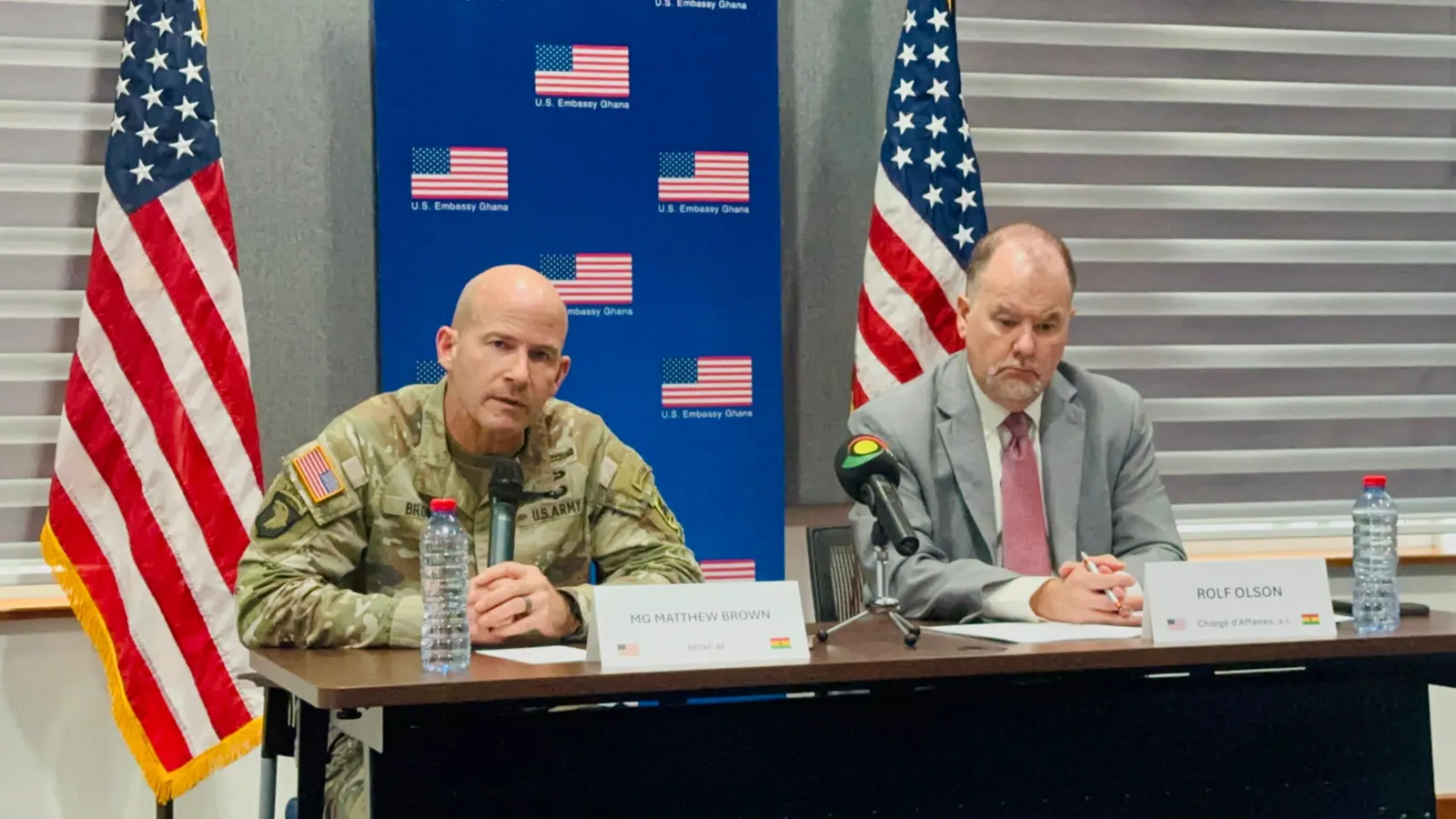
Major General Matthew W. Brown, Commanding General of the U.S. Army Southern European Task Force, Africa (SETAF-AF), has called for stronger African-led regional security cooperation to address the continent's evolving security challenges. He made the call during a media roundtable with selected journalists in Accra as part of his engagement with Ghanaian security authorities and other stakeholders. Maj. Gen. Brown emphasized that sustainable solutions to Africa's security challenges should be African-led, with the United States playing a complementary role.
The U.S. regards Ghana as an important and trusted security partner and would continue to engage Ghanaian authorities to better understand the country's security priorities and identify areas for enhanced cooperation. Maj. Gen. Brown's immediate priority is to gain a deeper understanding of the security challenges confronting Ghana, the country's approach to addressing them, and its plans for future force development. He said his main priority is understanding, explaining that the U.S. wanted to understand the assessments of Ghana's senior leadership on prevailing security threats and how the country intended to respond to them.
The long-standing military relationship between Ghana and the U.S. is built on mutual respect, shared interests and values, as well as common security concerns. The relationship provides opportunities for both countries to strengthen bilateral cooperation while supporting broader regional efforts to address security threats. The SETAF-AF, Maj. Gen. Brown said, was responsible for bringing together and integrating U.S. Army resources in support of the U.S. Africa Command (AFRICOM) campaign plan.
Maj. Gen. Brown, who assumed command of the task force in June 2026, succeeding Maj. Gen. Andrew C. Gainey, said its focus included security cooperation in the land domain, military exercises and engagements aimed at encouraging African countries to develop regional solutions to shared security challenges. He emphasized that some security challenges could only be effectively addressed when security forces from different countries worked together in complementary ways.
The U.S. would therefore leverage its existing relationships with African militaries, including the Ghana Armed Forces, to promote greater security cooperation across the region. Maj. Gen. Brown said lasting security was closely linked to economic opportunity, stressing that countries could not achieve enduring security without creating conditions for economic growth and development. He said his engagements in Ghana included meetings with senior government and military officials to understand their priorities and align U.S. military activities with Ghana's needs.
Mr. Rolf Olson, Chargé d'Affaires of the U.S. Embassy in Accra, said the continued visits by senior U.S. military officials reflected the importance Washington attached to dialogue with its African partners. He said Maj. Gen. Brown was the fourth senior U.S. military official to visit Ghana since the beginning of the year. The visits enabled U.S. officials to meet their Ghanaian counterparts, discuss priorities and identify areas where the U.S. could provide support.
The U.S. encourages its senior military officials responsible for the region to visit Ghana regularly, engage their counterparts and gain a better understanding of the country's priorities. Mr. Olson said the U.S. Embassy's objective was to ensure that senior military officials maintained regular engagement with their Ghanaian counterparts and remained responsive to areas where the U.S. could provide support.
Key points
- The U.S. seeks stronger African-led security cooperation with Ghana to address the continent's evolving security challenges.
- Maj. Gen. Brown emphasizes that sustainable solutions to Africa's security challenges should be African-led, with the U.S. playing a complementary role.
- The U.S. and Ghana have a long-standing military relationship built on mutual respect, shared interests and values, as well as common security concerns.