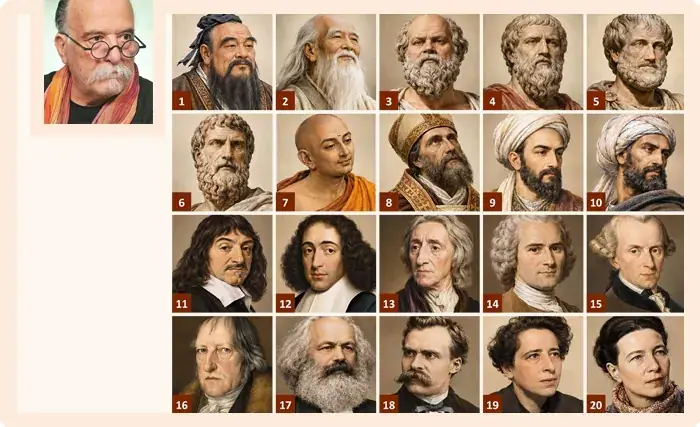
The quest for knowledge and understanding has been a driving force in human history, with philosophers continually posing fundamental questions about existence, morality, and freedom. A recent publication by Zouhaïr Ben Amor, a university academic, highlights twenty influential philosophers who have shaped our perspective on the world. This selection spans multiple civilizations and eras, offering a diverse and insightful look at the evolution of philosophical thought.
The list begins with Confucius, a Chinese philosopher from the 6th century BC, who emphasized the importance of benevolence, respect, and moral example in governance. His teachings stress the need for education and self-cultivation, making it accessible to people from all walks of life. Another ancient Chinese figure, Laozi, is credited with the Daodejing, a text that advocates for living in harmony with nature and embracing simplicity and humility.
Socrates, a Greek philosopher from the 5th century BC, is known for his method of questioning and dialogue, which aimed to challenge assumptions and arrive at a deeper understanding of justice, courage, and virtue. His approach emphasized the importance of recognizing one's own ignorance as a starting point for wisdom. Other influential Greeks include Plato, who explored the nature of reality and knowledge, and Aristotle, who developed a systematic approach to observation, logic, and research.
The list also features Épicure, a Greek philosopher who advocated for a life of moderation and the pursuit of happiness through the absence of pain and fear. Nāgārjuna, an Indian philosopher from the 2nd-3rd century AD, is known for his concept of "emptiness" or "vacuity," which challenges absolute positions and encourages a more nuanced understanding of reality. Augustin d'Hippone, a North African philosopher from the 4th-5th century AD, explored the nature of memory, time, and desire.
The publication also highlights the contributions of several philosophers from the Middle Ages and the Islamic Golden Age, including Avicenne and Averroès. Avicenne, a Persian philosopher from the 10th-11th century AD, made significant contributions to metaphysics and the study of consciousness. Averroès, a philosopher from Al-Andalus and the Maghreb, defended the use of reason and rational inquiry in understanding the world.
The modern era is represented by philosophers such as René Descartes, who developed a method based on doubt and clear ideas, and Baruch Spinoza, who saw God and Nature as a single, infinite reality. John Locke, an English philosopher, emphasized the role of experience in shaping our knowledge, while Jean-Jacques Rousseau, a Genevan philosopher, explored the social contract and the nature of inequality.
The list concludes with Immanuel Kant, a Prussian philosopher who examined the conditions of knowledge and the limits of reason, and Georg W. F. Hegel, who saw human reality as a dynamic and transformative process. Karl Marx, a German philosopher, studied the material conditions of production and the role of class conflict in shaping society.
Key points
- The selection offers a diverse and insightful look at the evolution of philosophical thought across multiple civilizations and eras.