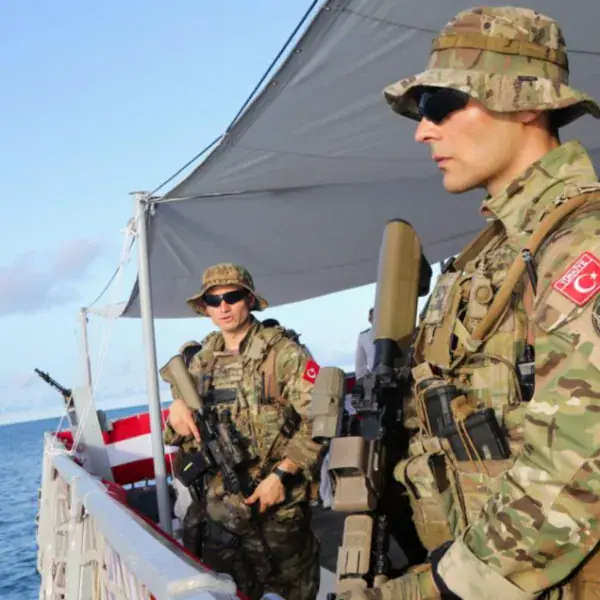
Turkish support for the Port Sudan authorities has evolved beyond supplying their forces with weapons and military equipment. A recent visit by a Turkish delegation to Port Sudan Naval Base between 2 and 5 November focused on inspecting maintenance and repair facilities and ship-lifting docks. The delegation also discussed ways to strengthen the Sudanese Navy's shipbuilding and maintenance capabilities with Sudanese Naval Forces Commander Mahgoub Bushra Ahmed Al-Rahman.
The visit reflects the expansion of military cooperation between Ankara and the Port Sudan authorities, transitioning from aerial armaments to maritime infrastructure development. This move is significant as Sudan's coastline assumes growing importance in regional and international power calculations due to its Red Sea location and military, logistical, and commercial opportunities.
Closer defence ties between Saudi Arabia and Türkiye may lead to a Turkish naval base on the Sudanese coast, according to Sudanese sources cited by Italy's Nova news agency on 11 November. The Mecca Defence Agreement signed by Saudi Arabia, Türkiye, and Pakistan on 7 August 2026 strengthens defence cooperation among the three countries. This agreement provides a framework for Ankara and Riyadh to coordinate their security interests in the region.
Russian President Vladimir Putin met with Sudan's Abdel Fattah al-Burhan on 28 and 29 October, during which Al-Burhan proposed establishing a Russian free economic zone on the Red Sea coast. This zone would include facilities for storing fuel and wheat, alongside cooperation in railway development and freight transportation. Al-Burhan also offered Russian companies access to sites for exploring gold, copper, and other minerals.
Documents obtained by The Washington Post reveal that Turkish companies discussed with Port Sudan authorities the possibility of granting them rights to develop and manage Abu Amama Port on the Red Sea. This includes investment opportunities in copper, gold, and silver mines, as well as fishing and fish-processing licences. These discussions demonstrate the intersection of military and economic interests in the relationship between Ankara and the Port Sudan authorities.
The expansion of military cooperation and economic concessions gives the Port Sudan authorities greater room to continue the war rather than engage in a process that would end the conflict. US Secretary of State Marco Rubio warned on 23 September that foreign interventions are prolonging the war, stating that the conflict "would not have happened without the active participation of outside actors fuelling one side of the conflict or the other".
The continued flow of external support gives the warring parties the capacity to sustain operations and bet on shifting the balance of power on the battlefield. On 6 October, Al-Burhan ruled out negotiations with the Rapid Support Forces (RSF) and vowed to continue military operations until areas under their control were retaken. This position places a major obstacle in the path of a political settlement.
Key points
- Turkish support for Sudan's Port authorities expands beyond military supplies to building strategic and economic interests tied to Sudan's coastline and natural resources.
- The expansion of military cooperation and economic concessions gives the Port Sudan authorities greater room to continue the war.
- Foreign interventions are prolonging the war in Sudan, according to US Secretary of State Marco Rubio.