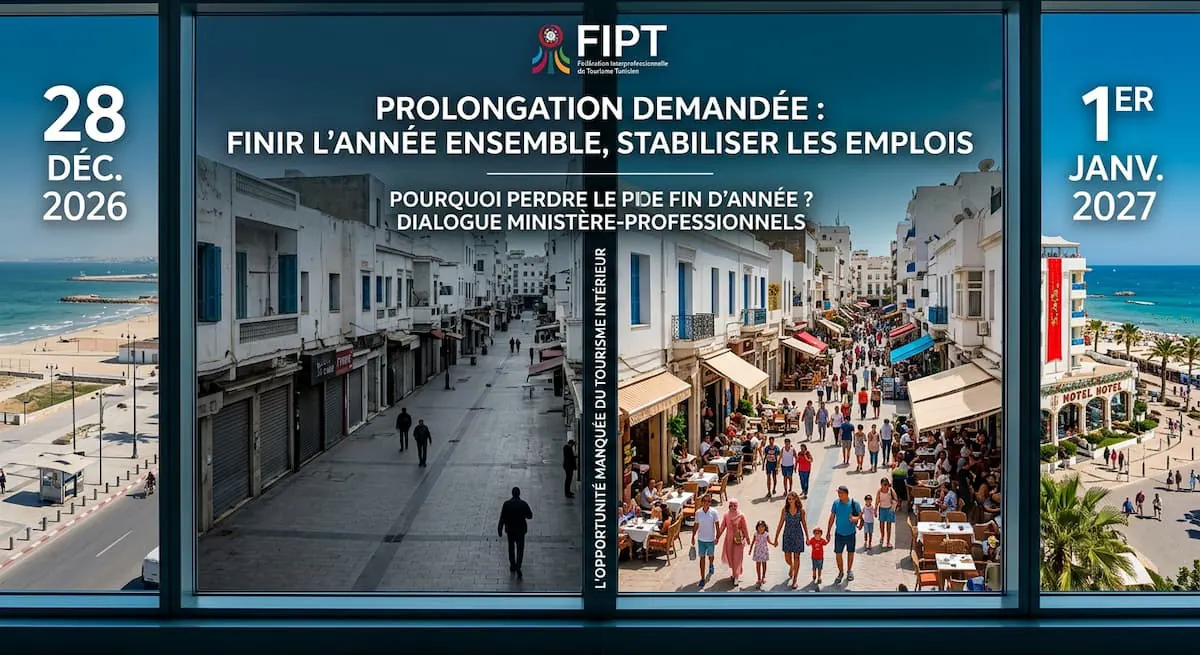
The Tunisian tourism industry is seeking to extend the winter break to January 1, 2027, as the current schedule set by the Ministry of Education may negatively impact the sector. The Interprofessional Federation of Tunisian Tourism (FIPT) made the request in a statement released on October 9, 2026. According to the FIPT, the current break from December 14 to 27 deprives families and professionals of year-end offers, threatening the domestic tourism activity that usually peaks during school breaks.
The FIPT warns that the current schedule would have consequences for travel agencies, hotels, alternative accommodation structures, and restaurants, as well as jobs in various regions. The organization proposes introducing a rotation of school breaks among the five regions, which would better distribute demand, particularly in inland regions, and alleviate pressure on establishments. This, in turn, would limit price hikes and improve the utilization of accommodation capacities.
A longer winter break would also spread out seasonal employment, which is prevalent in the sector, instead of concentrating it over a few weeks. This would stabilize workers' incomes and support the local economy. The FIPT's proposals are part of a participatory approach, calling for dialogue between the Ministry of Education and tourism stakeholders to ensure that the school calendar considers social, economic, and tourism-related concerns.
The Tunisian tourism sector has been facing challenges in recent years, with rising prices and changing consumer behavior. According to a recent report, hotel prices in Tunisia have increased significantly, making it difficult for some Tunisians to afford summer vacations. The FIPT's proposals aim to address these challenges and support the growth of the tourism sector.
The issue of school breaks and their impact on the tourism sector is not unique to Tunisia. Many countries face similar challenges, and the FIPT's proposals may offer a model for other countries to consider. However, the Tunisian government must balance the needs of the tourism sector with those of the education system and other stakeholders.
The FIPT's statement was released on October 9, 2026, and it is unclear how the government will respond to the organization's proposals. The tourism sector is a significant contributor to Tunisia's economy, and any changes to the school calendar could have a substantial impact on the sector's performance.
The Tunisian government must consider the potential consequences of its decision on the tourism sector and the broader economy. A longer winter break could have benefits for the sector, but it also requires careful planning and coordination with stakeholders. The government is expected to engage in dialogue with the FIPT and other stakeholders to find a solution that balances competing interests.
Key points
- The Tunisian tourism industry is seeking to extend the winter break to January 1, 2027.
- The Interprofessional Federation of Tunisian Tourism (FIPT) proposes introducing a rotation of school breaks among the five regions.
- A longer winter break would spread out seasonal employment and stabilize workers' incomes.