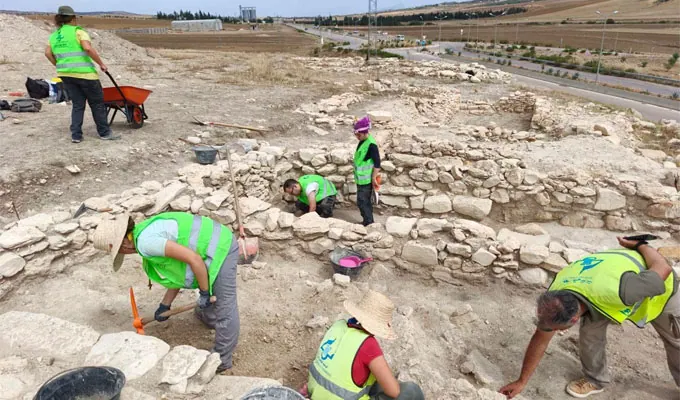
A recent archaeological mission, conducted from September 16 to October 6, 2026, has been carried out on the site of Sidi Saïd, located in the delegation of Bargou, Siliana governorate. The mission was a collaborative effort between the Tunisian National Heritage Institute (INP) and the Catalan Institute of Classical Archaeology (ICAC). This project is part of an international cooperation agreement between the two institutions. The mission aimed to further investigate the site, which had previously revealed the existence of a Numide urban complex.
The mission was co-directed by Tunisian researchers Yamen Sghaïer and Chokri Touihri from the INP, and Spanish researchers Maria Carme Belarte and David Montanero from the ICAC. The team comprised several researchers, conservators, and students from both countries. The excavation and prospecting works allowed for the continuation of documentation on the site's habitat structures and fortifications. These vestiges, described as particularly dense by the mission's archaeologists, date back to the Numide period, specifically between the 5th and 3rd centuries BC.
The site of Sidi Saïd has provided valuable insights into the organization of the indigenous populations in the region during the Numide period. The mission's findings have shed light on the site's significance and its relevance to understanding the history of the region. The project is part of a larger research initiative that began with preliminary excavations conducted between 2017 and 2018. A first large-scale campaign was also carried out during the summer of 2025.
The mission's investigations have contributed significantly to the understanding of the site's layout and its historical significance. The site's structures and fortifications are a testament to the advanced urban planning and architectural skills of the Numide civilization. The mission's findings have also highlighted the importance of preserving and protecting the site for future generations.
The collaboration between the INP and the ICAC has facilitated the exchange of knowledge and expertise between Tunisian and Spanish researchers. The mission's success is a reflection of the importance of international cooperation in the field of archaeology. The project's findings have been documented and will be published in scientific reports and publications.
The archaeological mission to Sidi Saïd is part of a broader effort to explore and understand Tunisia's rich cultural heritage. The site is one of several archaeological sites in the country that hold significant historical and cultural importance. The mission's findings have contributed to a greater understanding of Tunisia's history and its place in the Mediterranean region.
The mission's discoveries have sparked interest among archaeologists and historians, who are eager to learn more about the Numide civilization and its significance in the region. The site of Sidi Saïd has the potential to provide further insights into the history of the region and its cultural heritage. Further research and excavations are planned to uncover more secrets of the site.
Key points
- A joint Tunisian-Spanish archaeological mission has explored the Numide site of Sidi Saïd, providing insights into the region's ancient past.
- The mission, conducted from September 16 to October 6, 2026, was a collaborative effort between the Tunisian National Heritage Institute (INP) and the Catalan Institute of Classical Archaeology (ICAC).
- The site's structures and fortifications date back to the Numide period, specifically between the 5th and 3rd centuries BC.