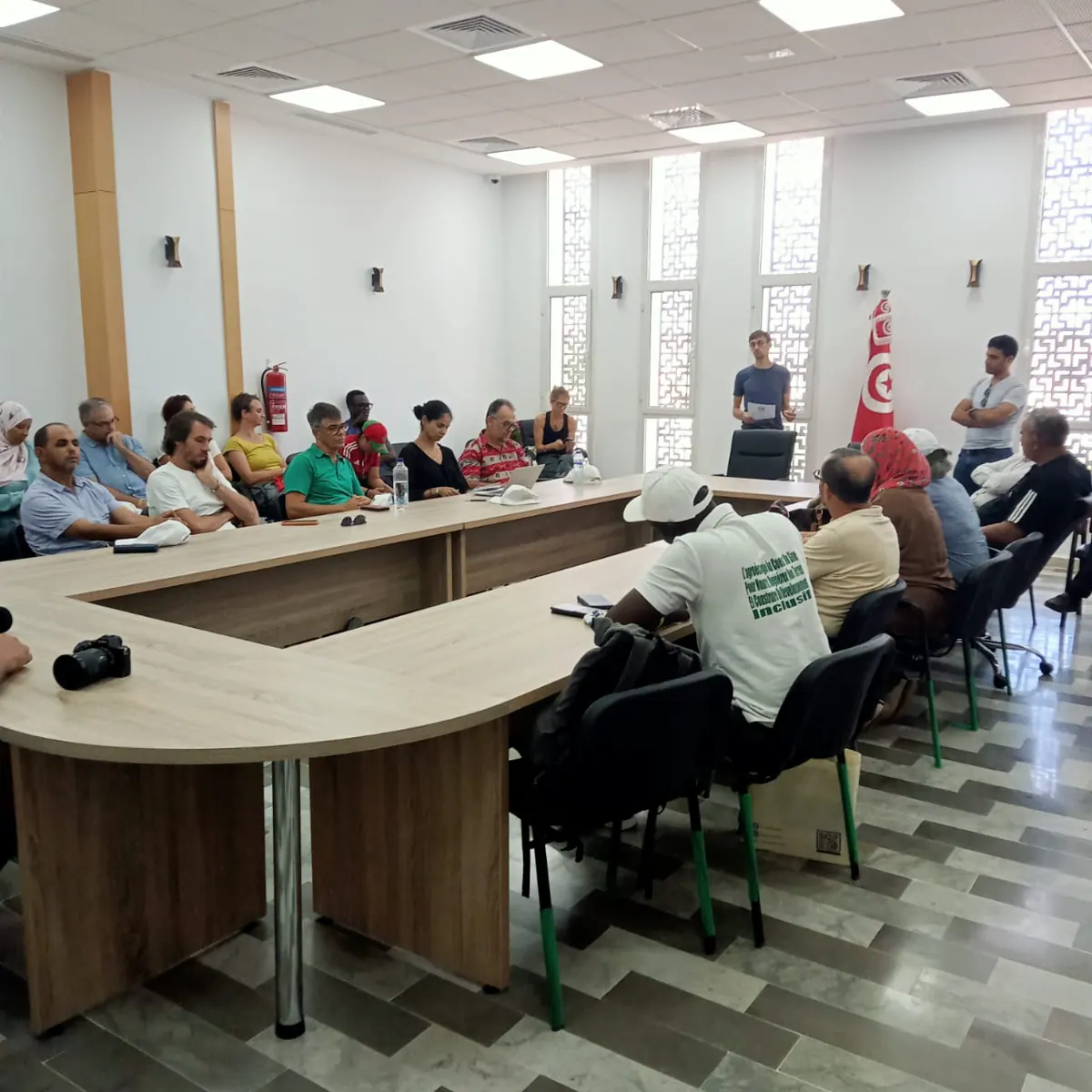
A group of researchers and stakeholders from the M.A.H.D.I.A project visited Chebika, a town in Tunisia's Kairouan governorate, as part of a field day that is part of the project's annual conference. The visit aimed to explore local agricultural experiences and exchange knowledge on sustainable agricultural practices and natural resource management. The project, which focuses on water resilience, ecological agriculture, and sustainable food systems, adopts a participatory approach that brings together researchers, farmers, and local stakeholders.
The visit included three main stops, starting with two farm visits, where participants learned about local agricultural practices and discussed issues related to farming, challenges, and opportunities linked to natural resources. The third stop was at the "Nissae Sabra" cooperative, which provides services to farmers and promotes local initiatives and agricultural development in the region. The visits were not just mere observations but turned into a space for dialogue and experience sharing between researchers and local stakeholders.
According to Dr. Nudira Ben Issa, a researcher at the Tunisian National Institute of Agricultural Sciences and a member of the M.A.H.D.I.A project team, the field day represents an extension of the project's work, allowing researchers to connect with local stakeholders and learn from their experiences. The project aims to produce knowledge and solutions that take into account the specificities of each region.
The M.A.H.D.I.A project focuses on the interlinked issues of water, agriculture, and food, considering the impact of climate change and pressure on natural resources. The project's approach allows researchers to listen directly to local stakeholders, while farmers and local stakeholders can share their experiences and present the challenges they face.
The visits to Chebika are part of a broader effort to understand the specificities of different regions, gather scientific knowledge, and local experiences. The project's findings will be compiled and transformed into messages and practices that can be used by stakeholders in the future.
With the project's end date approaching, these visits take on additional importance, as the annual conference in Hammamet will focus on compiling final results, evaluating them, and exploring ways to continue the work and experiments after the project's end.
The M.A.H.D.I.A project's activities will continue until November 30, 2026, and the annual conference will conclude on September 25, 2026. The project's outcomes are expected to contribute to the development of sustainable agricultural practices and water management in Tunisia.
Key points
- The M.A.H.D.I.A project adopts a participatory approach to sustainable agriculture and water management.
- The project focuses on water resilience, ecological agriculture, and sustainable food systems.
- The visits to Chebika aim to exchange knowledge and experiences on sustainable agricultural practices and natural resource management.