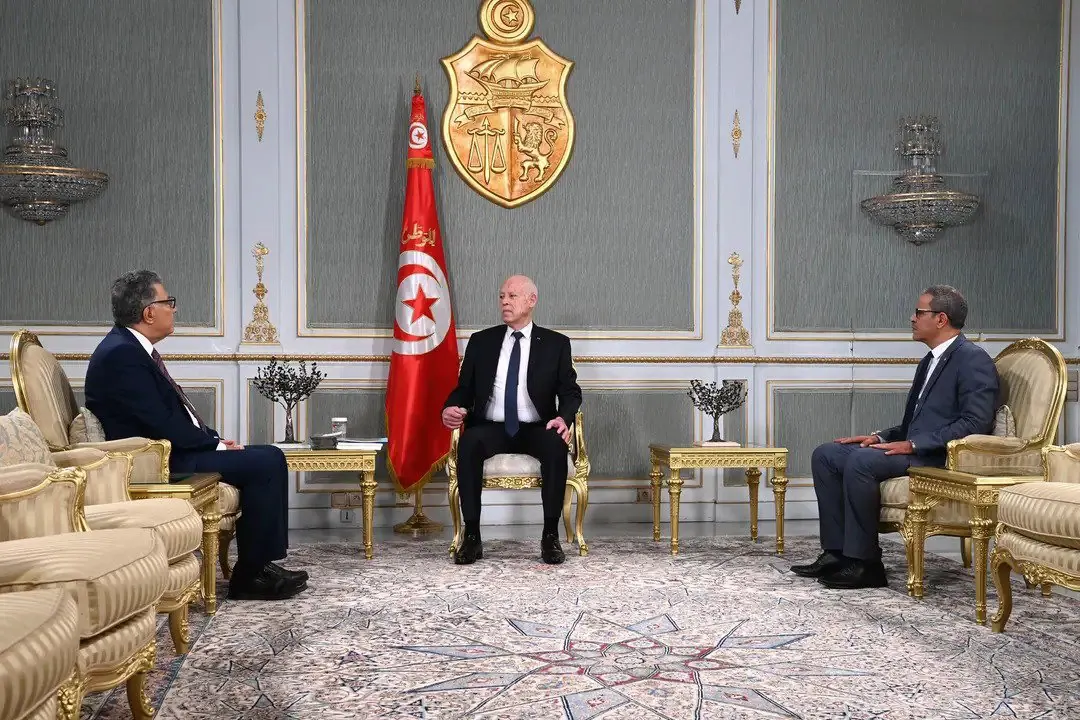
On October 8, 2026, Tunisian President Kaïs Saïed met with Brahim Bouderbala, President of the Assembly of People's Representatives, and Imed Derbali, President of the National Council of Regions and Districts, at the Carthage Palace. The meeting focused on various projects and proposals, including the social situation of citizens and ensuring complementarity between state functions, as defined by the Constitution. Saïed emphasized that despite numerous obstacles, the will to overcome them is strong.
During the meeting, Saïed highlighted the need for a new approach based on "revolutionary" concepts to respond to the expectations of the Tunisian people. He praised the "deep awareness" of the Tunisian people and called on officials to listen to citizens' concerns, share their difficulties, and work to eliminate their causes. Saïed's remarks underscored his commitment to addressing the country's challenges.
Saïed accused certain parties of attempting to divide the country and the state, but assured that these attempts would be thwarted by the Tunisian people's "historical awareness." He emphasized that the Tunisian state would remain united and would not succumb to "any blackmail." The President's statements reflect his determination to maintain state unity.
The President reiterated that accountability is a "legitimate requirement," but not driven by a desire for revenge. He assured that the Tunisian state is not weak and would not be left vulnerable to exploitation. Saïed promised that difficulties would be overcome and expected achievements would be realized.
Saïed stressed that accountability cannot be limited to statements and communiqués, but requires swift action. He noted that Tunisia is engaged in a "race against time" and that all truths would be revealed in due course, with no immunity or exceptions for anyone. His comments suggest a commitment to transparency and accountability.
The meeting between Saïed and top officials reflects the ongoing efforts to address Tunisia's challenges. The President's emphasis on state unity and accountability is seen as a key aspect of his strategy to overcome the country's obstacles. Saïed's approach has been characterized as "revolutionary," indicating a significant shift in the country's governance.
The implications of Saïed's statements and actions will be closely watched by Tunisians and international observers. The country's progress in addressing its social, economic, and political challenges will depend on the implementation of the President's vision and policies. Saïed's leadership will be crucial in determining the country's future trajectory.
Key points
- Tunisian President Kaïs Saïed emphasizes state unity and accountability.