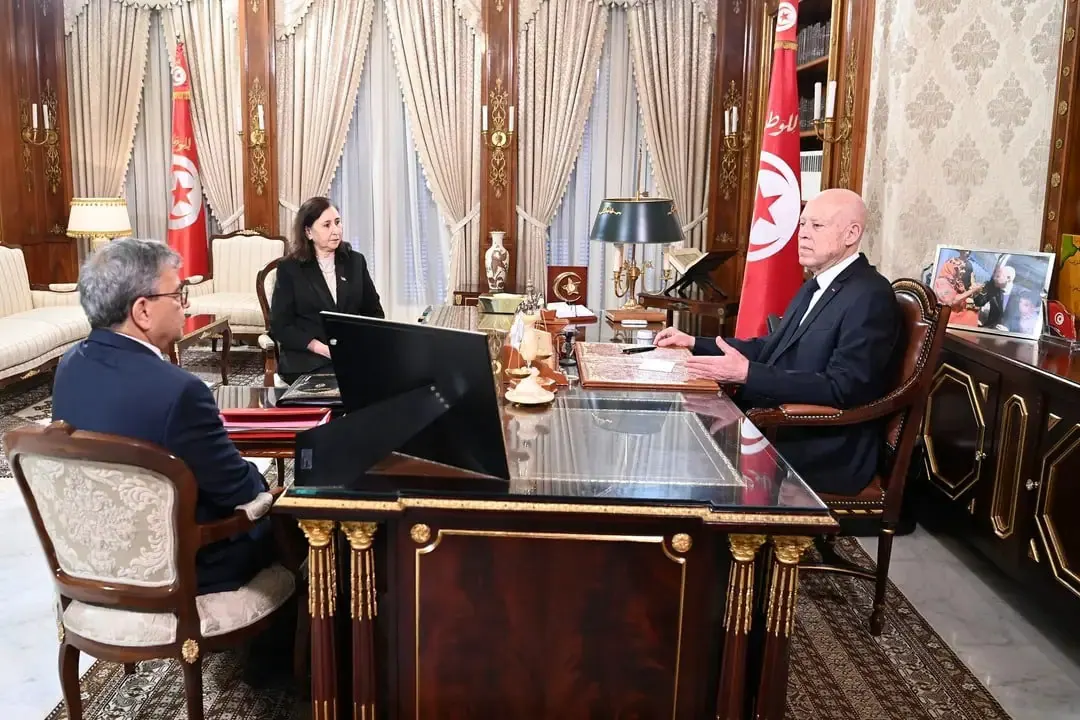
On September 23, Tunisian President Kaïs Saïed met with Prime Minister Sarra Zaafrani Zenzri and Central Bank Governor Fethi Zouhair Nouri to discuss the country's economic situation. The President emphasized the need for banks to play a stronger role in supporting the national economy, particularly in facilitating access to credit. He also stressed the importance of rationalizing imports to combat excessive price hikes. According to the presidency, these discussions aimed to find solutions to achieve financial equilibrium.
During the meeting, President Saïed highlighted the crucial role of the Central Bank in supporting the national economy and achieving financial equilibrium. He recalled that the creation of public banks aims to support state efforts and called on these institutions to provide advantageous credit conditions. The President also emphasized the need to respect the Central Bank's circulars, which regulate banking operations. This call to action aims to promote a more supportive banking environment for the economy.
President Saïed also discussed the concept of a social state, as enshrined in the Tunisian Constitution. He emphasized that this concept should not remain a mere slogan but become a tangible reality for citizens. The President highlighted the importance of public services, such as healthcare, education, and social coverage, which are ensured by the state. He stressed that the coexistence of public and private sectors should be based on social justice, ensuring a fair distribution of wealth.
The issue of excessive price hikes was also a major topic of discussion during the meeting. President Saïed insisted on the need to rationalize imports and pursue the fight against corruption without relenting. He defined corruption as a multifaceted phenomenon that includes not only bribery but also fraud, obstruction of public services, and mistreatment of administration officials. The President emphasized that these issues continue to worsen and must be addressed urgently.
According to President Saïed, the objective of corrupt practices and those who support them is to undermine the revolutionary process initiated by the people. He expressed confidence that as long as citizens remain aware of these objectives, attempts to disrupt the process will fail. The President also denounced those who seek to spread the idea that the revolution and the realization of people's demands for employment, freedom, and national dignity are mere illusions.
President Saïed rejected the notion that the situation was better before the December 17 revolution, which marked the beginning of the country's transition. He recalled that the people were then living under the weight of injustice and corruption, having "paid the price of blood to liberate themselves." The President affirmed that the people, having chosen to free themselves, will not be discouraged by these maneuvers, regardless of their origin.
In conclusion, President Saïed's call to action emphasizes the need for a stronger banking role, anti-inflation measures, and a more effective fight against corruption. The President's statements reflect his commitment to promoting a more just and equitable society, as enshrined in the Tunisian Constitution. The implementation of these measures will be crucial in achieving financial equilibrium and improving the living standards of Tunisian citizens.
Key points
- President Saïed calls for stronger banking role in supporting the economy.
- The President emphasizes the need to rationalize imports and combat corruption.
- President Saïed stresses the importance of implementing a social state, as enshrined in the Tunisian Constitution.