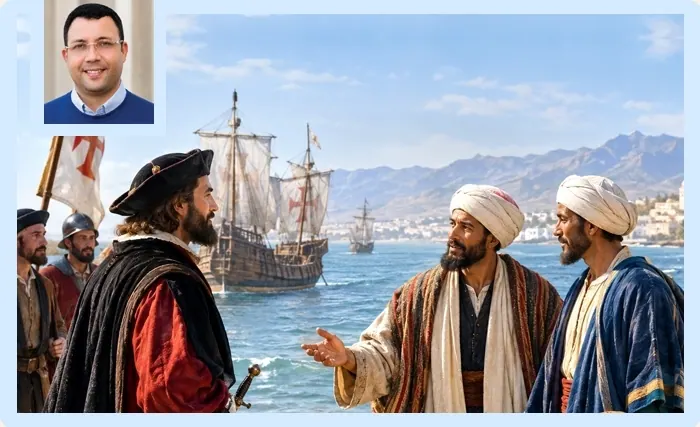
In May 1498, Portuguese navigator Vasco da Gama arrived in India after months at sea. His journey was long and arduous, but his arrival was a significant moment for the Portuguese kingdom, which had been searching for a maritime route to India for years. However, upon his arrival, da Gama was surprised to encounter two men from Tunis, who spoke Castilian and Genoese.
The two Tunisian merchants, described as "Maures de Tunis," were able to communicate with da Gama's envoy in their languages. They asked him about the purpose of the Portuguese expedition and were informed that they were seeking Christians and spices. The Tunisians then inquired why the kings of Castile, France, and the Seigneurie of Venice did not also send men to India.
The encounter between da Gama's envoy and the Tunisian merchants was documented in the Roteiro da Viagem de Vasco da Gama, a account written by a participant in the expedition. This historical account highlights the presence of Tunisian merchants in India before da Gama's arrival. It also underscores the linguistic and cultural exchange that occurred in the Mediterranean region during that time.
The story of the Tunisian merchants in India serves as a reminder of the country's rich history of mobility and trade. Long before the era of modern transportation and communication, Tunisian merchants were traveling, trading, and learning new languages. This history is worth recalling, not to fuel national pride, but to appreciate the depth and complexity of Tunisia's past.
Aymen Bouali, a Tunisian academic, reflected on this history in a recent article. He noted that the story of the Tunisian merchants in India challenges the notion that Tunisians have always been confined to their territory. Instead, it shows that they have a long history of exploration, trade, and cultural exchange.
Bouali's article highlights the importance of recalling and celebrating Tunisia's history of mobility and trade. By doing so, Tunisians can gain a deeper understanding of their country's place in the world and the ways in which it has been connected to other cultures and civilizations for centuries.
The legacy of Tunisian merchants in India continues to be an important part of the country's cultural heritage. It serves as a reminder of the country's historical connections to the Mediterranean region and its role in the global exchange of goods, ideas, and cultures.
Key points
- Tunisian merchants were present in India when Vasco da Gama arrived in 1498.
- The encounter between da Gama's envoy and the Tunisian merchants was documented in the Roteiro da Viagem de Vasco da Gama.
- The story highlights Tunisia's rich history of mobility, trade, and cultural exchange.