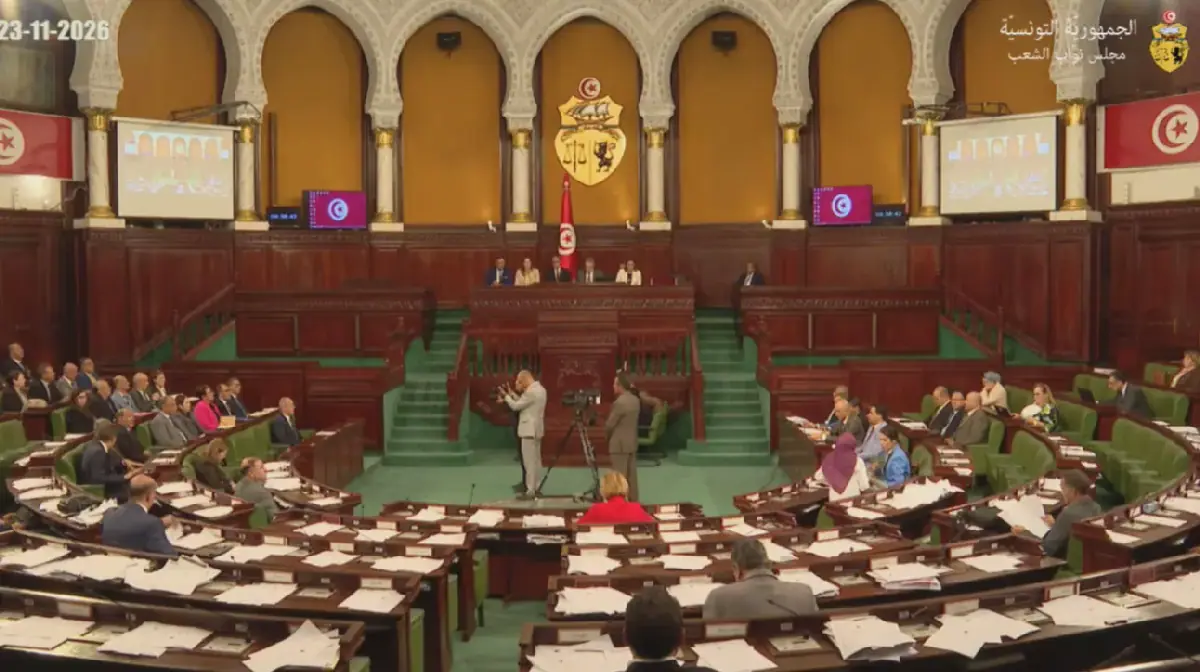
The Tunisian Parliament's National Assembly and Council of Regions and Districts held a joint session to discuss the 2027 state budget, specifically the environment ministry's allocation. The session highlighted regional concerns, with many lawmakers emphasizing the need for immediate solutions to sewage, waste, and pollution issues in their respective areas. They called for accelerating sewage project completion, addressing random waste dumping, and strengthening oversight of polluting institutions.
Lawmakers Loutfi Taher and Abdel Hafiz Al-Majri noted that the National Sanitation Office's intervention in Silyana Governorate is limited to four out of 11 delegations. Taher requested expanding the office's reach to at least eight delegations and providing additional resources. He also pointed out that only one of four wastewater treatment plants in the governorate has tertiary treatment capabilities, and it is underutilized.
Abdel Hafiz Al-Majri requested an additional truck for waste collection and disposal in Al-Krib, and accelerating the connection of the city to the sewage network. Kamel Al-Majri questioned the delay in expanding and upgrading the Bajah sewage treatment plant, which is one of 10 governorates included in the program. He expressed concerns about the project's cost and the impact of the Japanese yen's depreciation on the project's feasibility.
Several lawmakers criticized the government's "wait-and-see" approach to addressing environmental issues. Alaa Al-Ghuzwani noted that some areas in Fernana delegation lack access to sewage networks, while others have incomplete or non-functional sewage systems. He requested prioritizing the connection of Drushia 1 and 2 neighborhoods to the sewage network.
The issue of waste management also garnered significant attention. Sirin Al-Jazar called for urgent action to address random waste dumping and accumulation in Jammal delegation, Monastir Governorate. Abdel Hafiz Al-Majri suggested establishing waste collection centers in Al-Krib, Sidi Bourouis, and Qafur.
Aminah Al-Harbawi, representing the second region, highlighted that the Greater Tunis area generates over 40% of the country's waste, with the Sebkha Al-Sijumi becoming a source of odors and mosquitoes. She and other lawmakers, including Rym Balhaj Muhammad, proposed solutions such as converting waste into energy and implementing effective waste management strategies.
The discussion also touched on coastal protection and pollution issues. Lawmakers Hassan Al-Amari and Alaa Al-Ghuzwani questioned the criteria for excluding certain coastal areas in Jendouba and Tabarka from a €61 million Dutch-funded project aimed at protecting coastlines and preventing erosion. They requested assessments of ongoing projects and measures to address pollution and protect coastal ecosystems.
Key points
- Tunisian lawmakers urge government to address pressing environmental issues, including sewage, waste, and pollution.
Reporting sources
- Établissement de la Radiodiffusion-Télévision Tunisienne · Établissement de la Radiodiffusion-Télévision Tunisienne