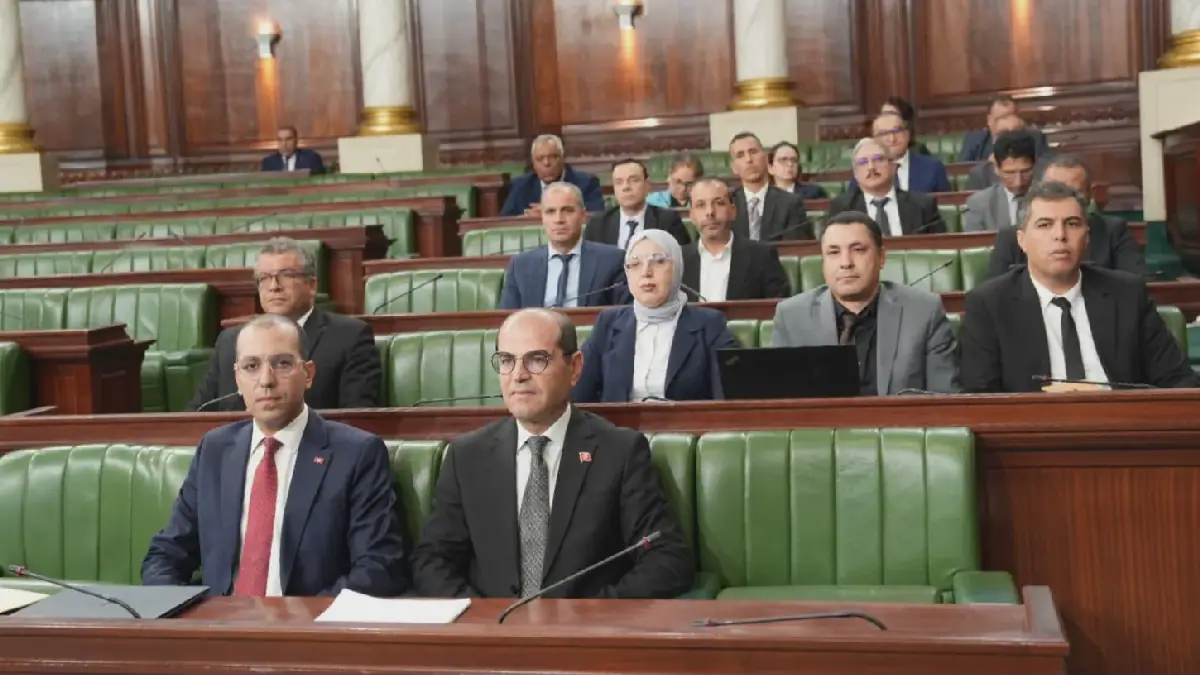
The Tunisian Parliament, comprising the Assembly of People's Representatives and the National Council for Regions and Districts, commenced a joint session on Sunday, November 22, 2026, to discuss the 2027 budget for the Ministry of Industry, Mines, and Energy. The session, held at the Bardo Palace, was attended by Minister of Industry, Mines, and Energy, Salah Zouaoui, and State Secretary for Energy Transition, Wael Chouchane. The proposed budget for the ministry's sector is approximately 7,884.221 million dinars in commitments and 7,890.221 million dinars in payments.
Compared to 2026, the proposed budget for 2027 represents a 48.2% increase in payment appropriations, rising from 5,319.606 million dinars in commitments and 5,325.619 million dinars in payments. The largest share of these allocations is dedicated to fuel subsidies, which are set to increase by 2,097 million dinars, or 42%, to 7,090 million dinars in 2027, up from 4,993 million dinars in 2026.
The budget also allocates 551.8 million dinars for development interventions, a significant increase from 60.5 million dinars in 2026, representing nearly an eightfold rise. This growth is primarily attributed to the allocation of 500 million dinars for a program financing chemical fertilizers for agricultural use, benefiting the Tunisian Chemical Group. The energy program is set to receive 7,200.1 million dinars, up from 5,115.8 million dinars in 2026.
The mining program's budget has been allocated 508.2 million dinars, a substantial increase from approximately 8 million dinars in 2026. This significant rise is mainly due to the allocations earmarked for the Tunisian Chemical Group. The objectives of the Ministry's sector, as outlined in a report by the Assembly of People's Representatives and the National Council for Regions and Districts, focus on enhancing the competitiveness of the industrial sector.
The report highlights the ministry's goals, which include promoting investment, improving the business climate, and developing national resources while ensuring optimal exploitation of hydrocarbons and mining resources. Additionally, the ministry aims to promote renewable energies and accelerate the transition towards a low-carbon energy model. These objectives align with the ministry's efforts to strengthen the industrial fabric and enhance national resource management.
The priorities of the Ministry's sector also encompass supporting and modernizing institutions, preparing industrial infrastructure, and restoring the natural rhythm of phosphate and fertilizer production. Furthermore, the ministry seeks to reduce polluting gas emissions and implement an energy transition program in public institutions. These initiatives are integral to the government's strategy for sustainable development.
The ongoing discussions in the Tunisian Parliament reflect the government's commitment to addressing key sectors that drive the country's economy. As the Assembly of People's Representatives and the National Council for Regions and Districts engage in these deliberations, they aim to ensure that the allocated budgets effectively support the nation's development goals and foster a more competitive and sustainable economy.
Key points
- The Tunisian government has allocated 7,090 million dinars for fuel subsidies in 2027, a 42% increase from 2026.
Reporting sources
- Établissement de la Radiodiffusion-Télévision Tunisienne · Établissement de la Radiodiffusion-Télévision Tunisienne