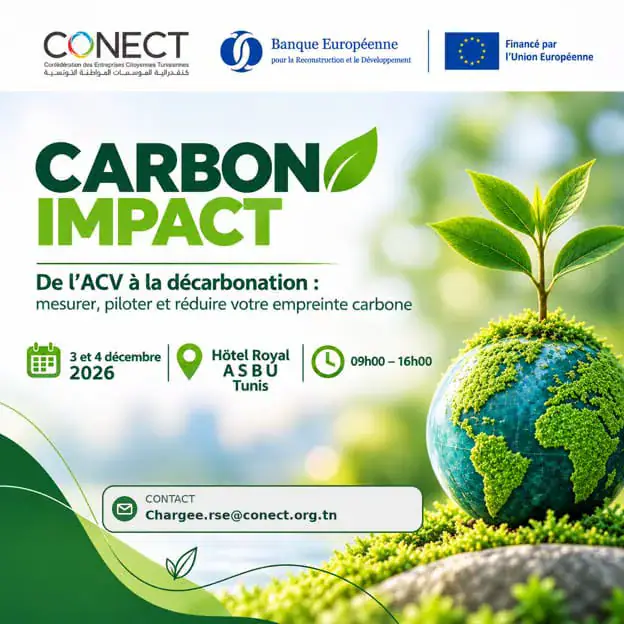
The Tunisian Confederation of Citizen Enterprises, "Konakt", in partnership with the European Bank for Reconstruction and Development and funded by the European Union, is organizing a two-day training session in Tunis on December 3-4, 2026. The session focuses on measuring and reducing the carbon footprint of institutions. This initiative aims to support environmental transition and enhance the capabilities of Tunisian institutions, particularly in response to new environmental requirements and sustainability reports.
The training session is part of Konakt's cooperation with international partners to promote sustainable development in Tunisia. The deadline for registration was set for November 30, 2026. The session will cover key aspects of carbon footprint measurement, including identifying primary sources of emissions and analyzing results to develop an initial action plan for decarbonization. Participants will benefit from a practical approach, led by expert Ahmed Chawashi, focusing on real-life cases and interactive discussions.
The training session targets institutions seeking to understand and mitigate their environmental impact. By the end of the session, a selected group of around 10 institutions will receive tailored support for three days, including an in-depth assessment of their carbon emissions and a customized action plan. This support aims to enable institutions to effectively reduce their carbon footprint and enhance their competitiveness in the international market.
The initiative is crucial for Tunisian institutions, especially in light of the new carbon border adjustment mechanism (MACF). This mechanism has made controlling carbon emissions a key factor in enhancing competitiveness and accessing international markets. The training session will equip participants with the necessary tools and knowledge to navigate these new environmental requirements and capitalize on opportunities for sustainable growth.
Ahmed Chawashi, the expert leading the training, will provide participants with a comprehensive understanding of carbon accounting principles. The session will focus on identifying primary sources of emissions, analyzing results, and developing initial orientations for a decarbonization action plan. This will enable institutions to make informed decisions and implement effective strategies for reducing their carbon footprint.
The collaboration between Konakt and international partners reflects a broader effort to promote sustainable development in Tunisia. By supporting institutions in their environmental transition, Konakt aims to contribute to the country's long-term sustainability goals. The training session is a significant step towards empowering Tunisian institutions to address environmental challenges and capitalize on opportunities for growth.
The impact of this initiative will be closely watched, as Tunisian institutions seek to balance economic growth with environmental sustainability. With the global focus on climate change and carbon emissions, such initiatives are crucial for promoting sustainable practices and reducing the environmental footprint of institutions. The success of this training session could pave the way for further collaborations and sustainability initiatives in Tunisia.
Key points
- Konakt's training session aims to support Tunisian institutions in measuring and reducing their carbon footprint, enhancing their competitiveness in the international market.