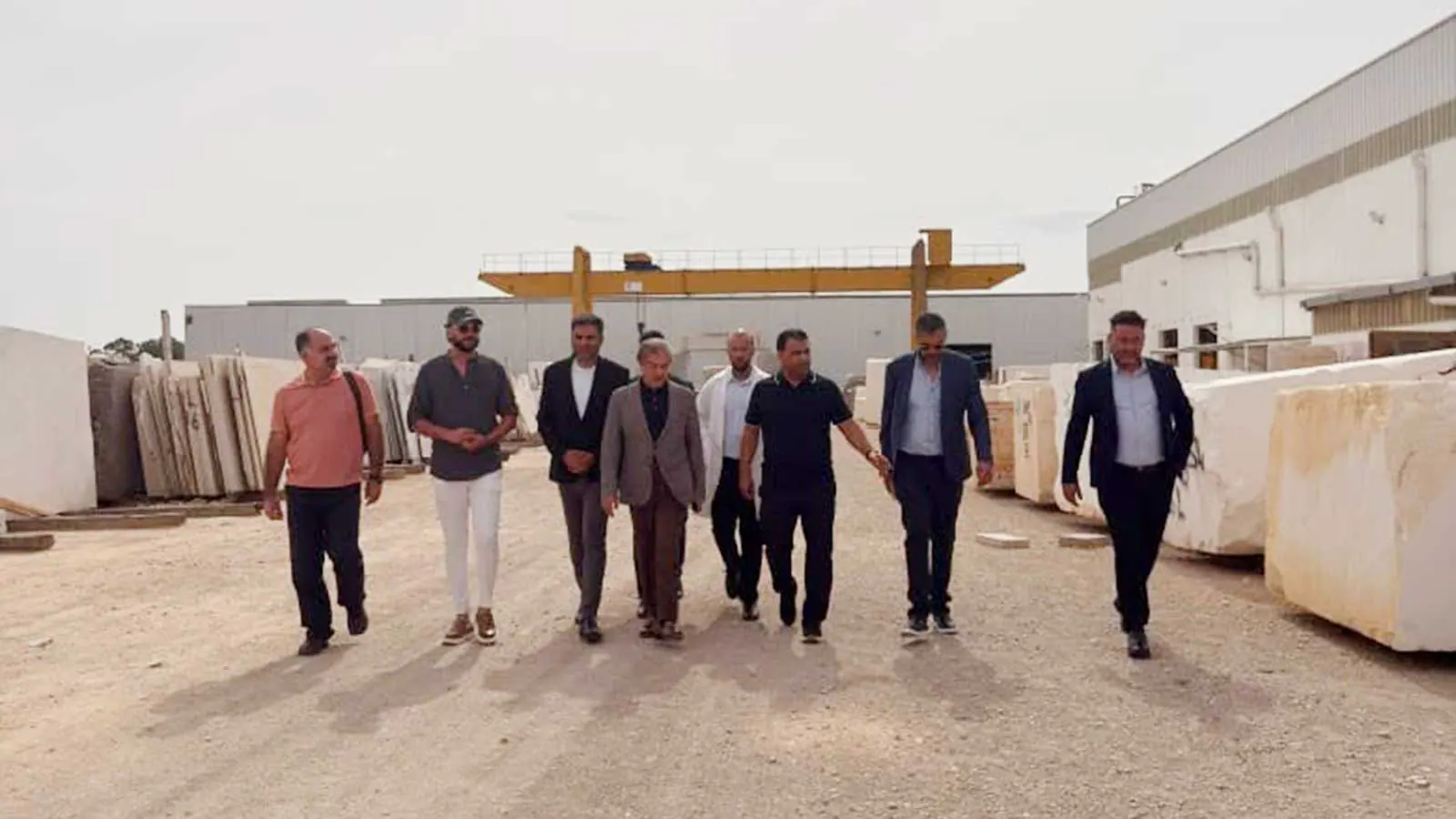
The Tunisian natural stone sector recently drew the attention of Ahmed Misbah Demircan, the Turkish Ambassador to Tunisia. On October 8, 2026, the ambassador visited Simarbre, a company specializing in natural stone and marble processing in Béja, Tunisia. This visit was part of the ambassador's efforts to engage with Tunisian business circles and productive sectors. The ambassador was accompanied by a delegation, including the commercial counselor of the Turkish Embassy in Tunisia, Salahaddin Batur.
During the visit, the ambassador and his delegation were given an overview of Simarbre's activities, including the various stages of natural stone processing and its export-oriented operations. They observed the cutting of natural stone blocks, their treatment, and transformation into slabs. Discussions also focused on the company's production capacity, its activities in the natural stone sector, and its operations in external markets. This visit highlights the interest of Turkish diplomacy in Tunisian productive sectors, particularly those with an export focus.
Simarbre, located in Béja, processes several varieties of Tunisian natural stones, including Thala Beige, Thala Grey, Sahara Noir, and others. The company produces blocks, slabs, and polished slabs primarily for export. According to its social media publications, Simarbre offers slabs in Thala Grey, available in different thicknesses, and markets natural stone slabs for various interior and exterior uses. The company's production unit is equipped with advanced machinery, including a vacuum system for block reinforcement and a polishing line.
The production unit of Simarbre features specialized equipment that allows it to carry out several stages of natural stone transformation, from raw blocks to treated slabs ready for marketing. This equipment includes single-blade and multi-blade cutting systems, a resin epoxy treatment line, and a slab polishing line. Such investments enable Simarbre to control several steps of the production process within its own facilities, enhancing its efficiency and product quality.
The visit by the Turkish Ambassador to Simarbre is part of a broader approach to maintaining contact with Tunisian companies and actors in various productive sectors. This approach reflects a particular interest in activities oriented towards external markets. By engaging with businesses like Simarbre, the Turkish Embassy in Tunisia aims to strengthen bilateral economic ties and explore opportunities for cooperation in the natural stone sector.
The presence of the Turkish Ambassador and his delegation at Simarbre underscores the importance of the natural stone sector in Tunisia's economy, particularly in terms of export potential. With its rich geological resources, Tunisia offers a variety of high-quality natural stones that are in demand internationally. Simarbre's focus on producing slabs for export markets aligns with the country's efforts to increase its presence in global trade.
The engagement between Turkish diplomacy and the Tunisian natural stone sector may pave the way for future collaborations or partnerships. As Tunisia seeks to expand its exports and diversify its economy, attracting foreign interest and investment becomes crucial. The visit to Simarbre highlights the potential for sector-specific cooperation between Tunisia and Turkey, with possible implications for trade and economic relations between the two countries.
Key points
- The Turkish Ambassador to Tunisia visited Simarbre, a natural stone company in Béja, to engage with Tunisian business circles and explore export opportunities.
- Simarbre specializes in processing Tunisian natural stones into blocks, slabs, and polished slabs for export markets.
- The visit reflects Tunisia's efforts to attract foreign interest and investment in its productive sectors, particularly those with export potential.