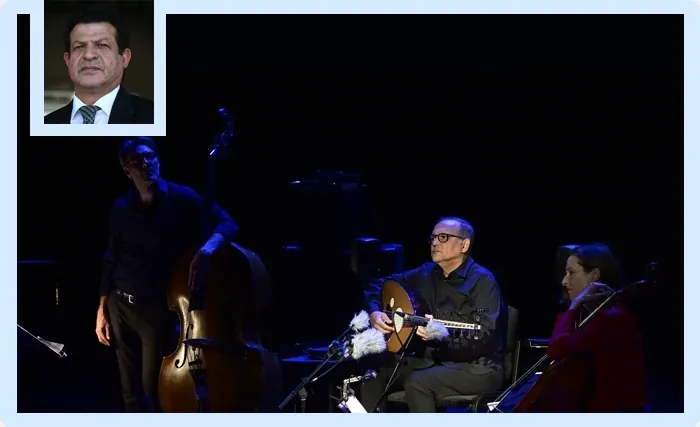
The 21st edition of the Arabesques Festival in Montpellier, France, featured a performance by Tunisian musician Anouar Brahem and his quartet on September 11, 2026. The event, titled "After the Last Sky," took place at the Amphithéâtre d'O du Domaine d'O. This year's festival, which ran from September 8 to 20, showcased various artists from the Arab world, including Oum, Bachar Mar-Khalifé, and Souad Massi. Brahem's performance was highly anticipated, given his significant contributions to Tunisian and international music.
The title of Brahem's performance, "After the Last Sky," is inspired by a line from Palestinian poet Mahmoud Darwich: "Où les oiseaux doivent-ils voler après le dernier ciel?" This phrase was later used by Edward Said in his 1986 book "After the Last Sky: Palestinian Lives," which explored the Palestinian condition. The title reflects the themes of displacement, war, and destruction, while also highlighting the resilience and attachment to one's land and heritage.
Brahem's quartet consisted of Anja Lechner on cello, Django Bates on piano, and Mats Eilertsen on double bass. The performance was characterized by a harmonious balance between the four musicians, with Brahem allowing ample space for the other instrumentalists to shine. The cello, in particular, added a touching warmth and gravity to the music. The quartet's interplay created a dynamic and engaging sound that was both captivating and thought-provoking.
The concert featured a mix of accessible and more complex musical sequences, requiring the audience's active engagement. While some parts were immediately captivating, others demanded more attention and effort to fully appreciate. This musical complexity was a hallmark of Brahem's style, which eschews easy seduction in favor of a more nuanced and challenging experience.
Brahem's music often explores themes of loss, anxiety, and hope, without explicitly referencing current events. His approach is one of suggestion rather than direct statement, leaving room for individual interpretation. In the context of the ongoing conflict in Gaza, the performance took on a new layer of significance, with the "last sky" evoking the unattainable refuge for those displaced and forced to flee.
The performance was not a direct translation of the Palestinian tragedy but rather an echo of its emotional resonance. Brahem's music captured the fragility and uncertainty of the human experience, while also conveying a sense of hope and resilience. As the audience departed the venue, they were left to ponder the question posed by Darwich: "Où les oiseaux doivent-ils voler après le dernier ciel?"
The concert was a testament to Brahem's skill as a musician and his ability to craft a unique sound that is both personal and universal. His performance at the Arabesques Festival was a highlight of the event, showcasing the power of music to transcend borders and evoke powerful emotions. Brahem's work continues to inspire and challenge audiences, solidifying his position as a leading figure in Tunisian and international music.
Key points
- Anouar Brahem's quartet performed "After the Last Sky" at the Arabesques Festival in Montpellier, France, on September 11, 2026.
- The performance explored themes of displacement, war, and destruction, while highlighting resilience and attachment to one's land and heritage.
- Brahem's music is characterized by its complexity, nuance, and emotional resonance, leaving a lasting impact on audiences.