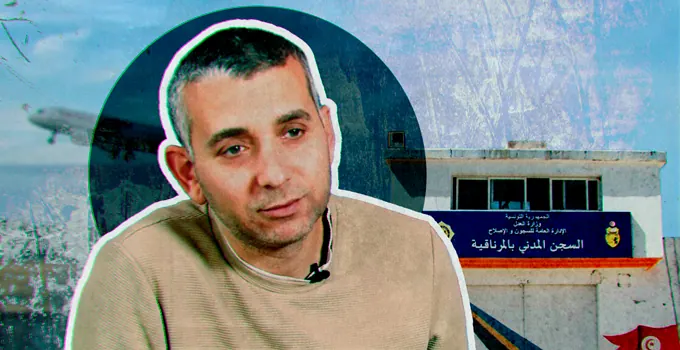
Haythem Mekki, a Tunisian journalist and satirist, has been sentenced to one year in prison for expressing his opinion on social media. Mekki, known for his sharp humor and criticism of the government, was convicted under Article 86 of the Telecommunications Code, which punishes anyone who intentionally harms others or disturbs their peace through public telecommunications networks. The sentence was handed down by the Sfax Court of Appeal on July 15, 2026.
Mekki's case is not an isolated incident in Tunisia, where dozens of people have been forced into exile due to restrictions, harassment, and unjust convictions in politically motivated cases. Despite this, Mekki has continued to exercise his right to freedom of expression, criticism, and satire since 2011, regardless of the government in power. He has worked for several media outlets, including Mosaique FM, where his satirical commentary was widely followed.
The case against Mekki dates back to 2024, when he was investigated for a post on social media in which he reported that the morgue at Habib Bourguiba Hospital in Sfax had reached capacity, leading to the accumulation of bodies of migrants who had died at sea. The hospital had confirmed the information, but Mekki was nonetheless charged and convicted. His conviction has been widely criticized by human rights groups and journalists' organizations.
The Tunisian Journalists' Union (SNJT) has condemned Mekki's sentence, saying it is part of a broader pattern of authorities using punitive measures to restrict journalists' freedom of expression and publication. SNJT President Zied Dabbar said that prosecuting journalists for their opinions or publications on public affairs creates a climate of intimidation and self-censorship, undermining the role of the media in stimulating public debate.
Mekki's brother, Thameur Mekki, editor-in-chief of the platform "Rachma", said that the verdict was unexpected given the facts of the case and the lack of evidence against Haythem. He noted that the information published by Haythem had been confirmed by representatives of the Ministries of Health and Justice, as well as regional authorities. Haythem Mekki has since gone into exile, but remains concerned about the situation of those who remain in Tunisia.
The sentence against Mekki has raised concerns about the state of press freedom in Tunisia, which has deteriorated significantly since the July 25, 2021 coup. The new regime has imposed strict controls on the media, with many journalists facing prosecution and imprisonment for expressing their opinions. The SNJT has called for the adoption of guarantees provided by Decree 115 on press freedom, publication, and expression.
Mekki's case highlights the challenges faced by journalists in Tunisia, where the government has sought to restrict freedom of expression and impose a narrative of propaganda. Despite these challenges, Mekki and other journalists continue to speak out against injustice and advocate for human rights and press freedom. Mekki has expressed his gratitude for being able to leave Tunisia before his arrest, but remains concerned about the situation of those who remain.
Key points
- The sentence against Haythem Mekki is part of a broader crackdown on press freedom in Tunisia.
- Mekki's case highlights the challenges faced by journalists in Tunisia, where the government has sought to restrict freedom of expression.
- The Tunisian Journalists' Union has condemned Mekki's sentence and called for greater protections for journalists.