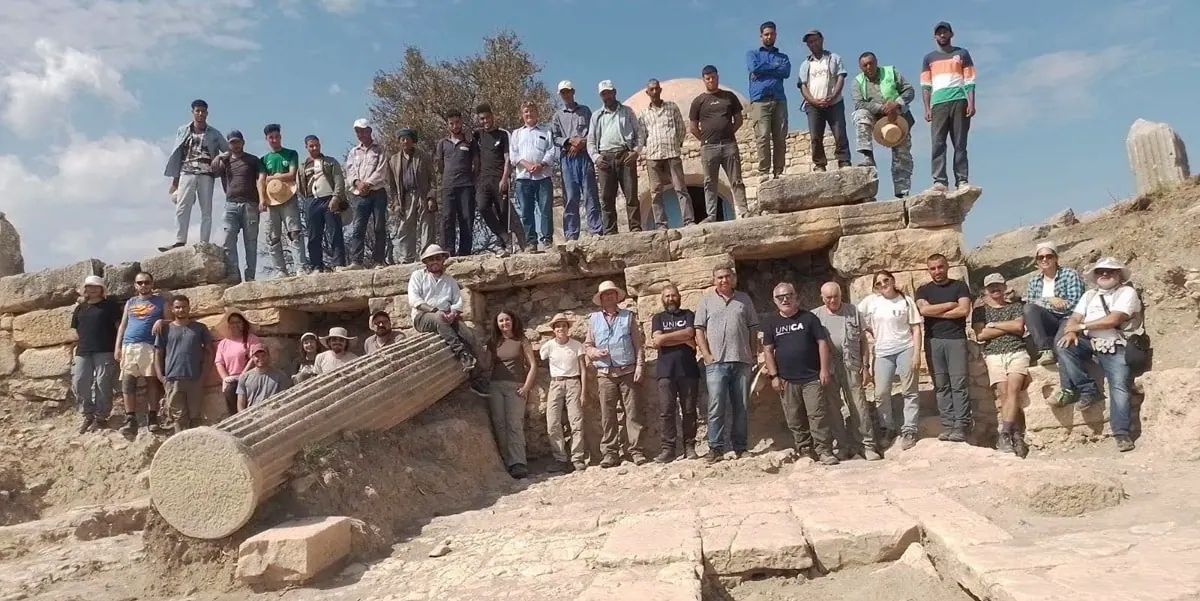
A recent archaeological campaign at Henchir El Materia, north of Teboursouk in the Béja governorate, has shed new light on the ancient city of Numluli. The excavation, conducted by the Tunisian National Heritage Institute (INP) and the University of Sassari in Italy, took place from September 6 to October 4, 2026. The team comprised researchers and students who worked together to study and valorize two significant sectors of the ancient city. Their efforts have yielded valuable insights into Numluli's history and daily life.
One of the sectors explored is the Capitole of Numluli, a Roman religious edifice built in 170 AD. The excavation focused on the public square, a fountain, and various architectural and decorative elements associated with the temple. Archaeologists discovered several chapiteaux, columns, geometric motifs, and statue fragments. These findings provide additional information on the organization of Numluli's monumental and public space during the Roman period. The team's discoveries have significantly enhanced understanding of the city's layout and architecture.
The second sector investigated corresponds to a church built in the mid-5th century during the Vandal period. The complex includes funeral spaces associated with Christian notables, various rooms, and delimiting structures. The excavation also uncovered jarres funéraires and large vertical jars used for storing provisions. Notably, remarkably well-preserved mosaic pavements were identified, adding to the significance of the findings. These discoveries offer a glimpse into the daily life and practices of the city's inhabitants.
The campaign's results have deepened knowledge of Numluli during Late Antiquity, documenting its religious and funeral spaces, as well as aspects of daily life and storage practices. The excavation has provided a wealth of information on the city's history, architecture, and culture. The joint Tunisian-Italian effort has contributed significantly to the scientific documentation and valorization of the archaeological heritage in the Béja region.
The archaeological campaign is part of the ongoing cooperation between Tunisia and Italy in the field of archaeology. The collaboration aims to promote the discovery and preservation of cultural heritage sites in Tunisia. The findings at Numluli are a testament to the rich history and cultural significance of the region. Further excavations and research are expected to uncover more secrets about the ancient city.
The discoveries at Numluli have sparked interest among archaeologists, historians, and the general public. The site's significance extends beyond its historical value, as it also provides insights into the daily lives of people who lived there. The excavation has highlighted the importance of preserving cultural heritage and promoting archaeological research in Tunisia. The Tunisian-Italian team's work has set a positive precedent for future collaborations.
The excavation campaign has concluded, but the work is far from over. The findings will be analyzed and studied further, and the results will be published in academic journals. The discoveries at Numluli will also be presented to the public through exhibitions and educational programs. The project aims to raise awareness about the importance of cultural heritage and promote a greater understanding of Tunisia's rich history.
Key points
- A joint Tunisian-Italian archaeological campaign has discovered new vestiges at Numluli, an ancient city in northern Tunisia.
- The excavation uncovered a Roman Capitole built in 170 AD and a Vandal-period church, providing insights into the city's history and daily life.
- The findings have contributed significantly to the scientific documentation and valorization of the archaeological heritage in the Béja region.