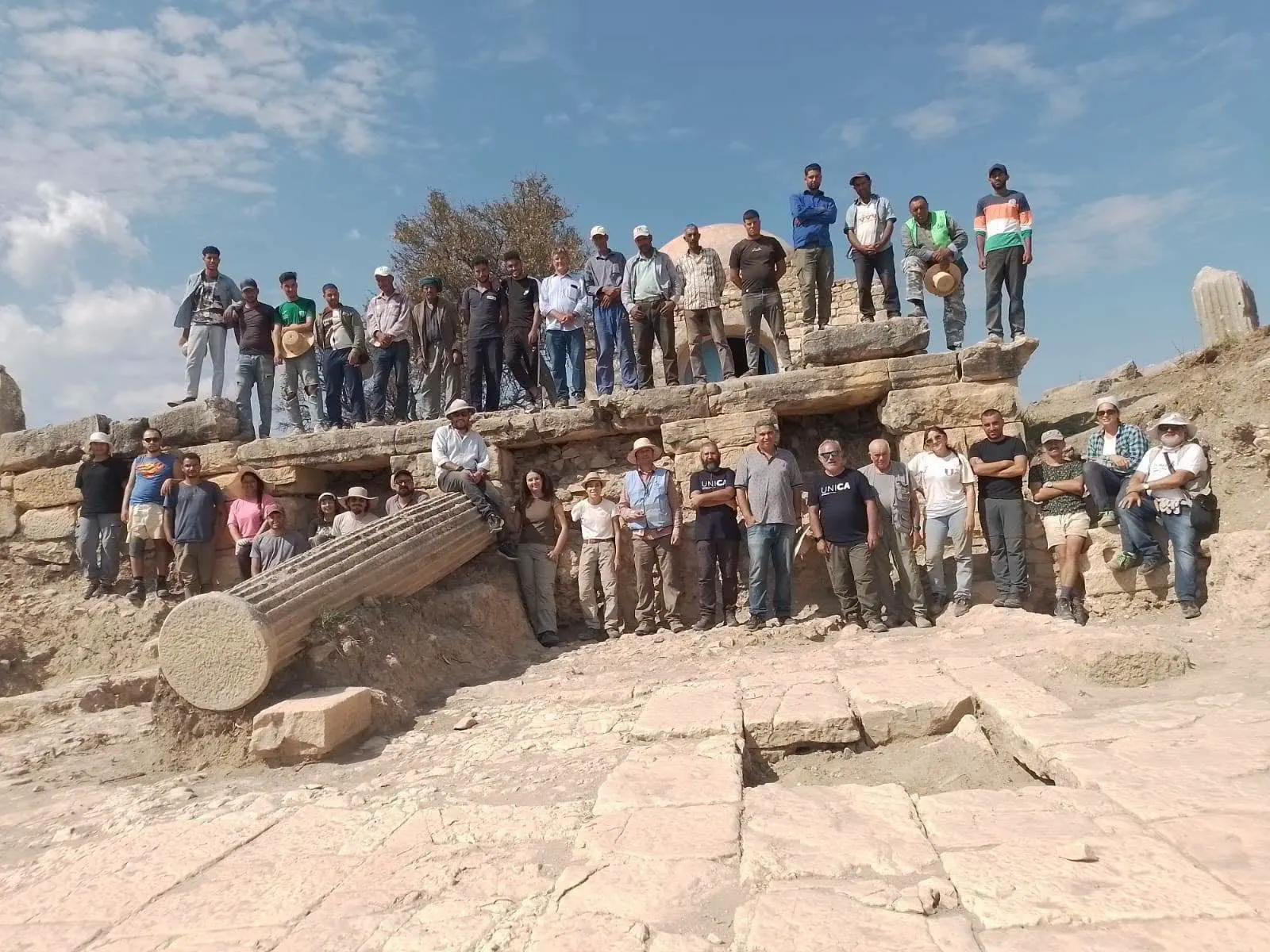
A team of researchers and students from Tunisia's National Institute for Heritage and Italy's University of Sassari has conducted a successful archaeological dig at the Henchir El Matria site, located north of Teboursouk in the governorate of Baga. The excavation, which took place from September 6 to October 4, 2026, uncovered various Roman-era structures. The site is part of the ancient city of Numluli, which dates back to the Roman period.
The dig focused on two main areas of the ancient city. The first area is the site of the Capitol Temple, built in 170 AD. The team discovered a public square, a fountain, and various temple components, including capitals, columns, and geometric decorations. These findings all date back to the Roman era. The temple is a significant discovery, providing insights into the city's ancient architecture and culture.
The second area of the dig contained a church and a basilica built in the mid-5th century AD. The team found several Christian tombs, different rooms, walls, and various artifacts, including funeral jars and storage containers. The most notable discovery was a set of unique mosaic panels, which reflect the lifestyle of the city's inhabitants during the late Roman period.
The excavation was conducted under an international cooperation agreement between the National Institute for Heritage and the University of Sassari. The partnership allowed for the exchange of expertise and resources, leading to significant discoveries. The findings will contribute to a better understanding of the history and culture of the region.
The discoveries at Henchir El Matria provide valuable insights into the lives of the people who lived in Numluli during the Roman era. The site offers a unique opportunity to study the architecture, art, and daily life of the ancient city. Further analysis of the findings will help researchers to reconstruct the city's history and its significance in the Roman Empire.
The Tunisian-Italian archaeological team has made a significant contribution to the field of archaeology with this discovery. The findings will be preserved and studied further, providing a wealth of information about the region's rich history. The collaboration between the two institutions has demonstrated the importance of international cooperation in archaeological research.
The discovery of the Roman ruins at Henchir El Matria is a significant addition to Tunisia's cultural heritage. The site will be protected and conserved, allowing future generations to learn about the country's rich history. The excavation has also highlighted the importance of preserving cultural heritage sites and promoting archaeological research.
Key points
- The discovery of Roman-era ruins at Henchir El Matria, including a Capitol Temple and a church, provides insights into the history and culture of the ancient city of Numluli.