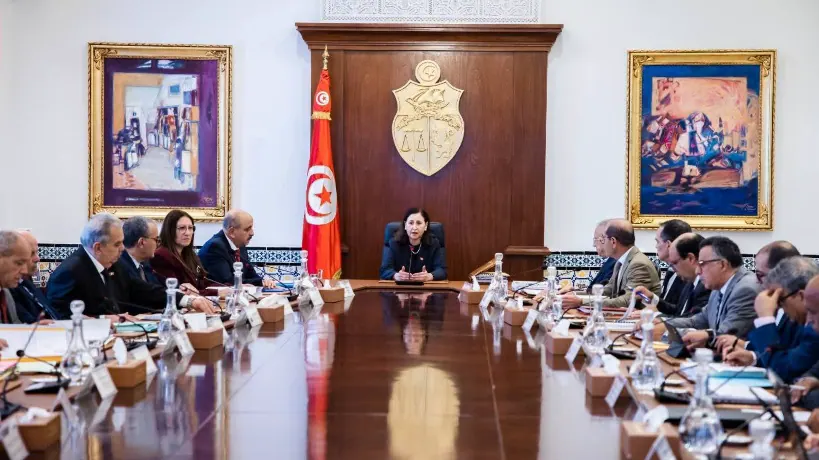
On October 8, 2026, Tunisian Prime Minister Sara Zenzari led a meeting of the High Commission for Major Projects to assess the progress of several large-scale public initiatives. The meeting, held at the Government Palace in Kasbah, focused on projects in energy, healthcare, infrastructure, transportation, and sports. Zenzari emphasized the government's commitment to accelerating the implementation of these projects, in line with President Kais Saied's directives to support economic and social development.
The commission reviewed the progress of several key projects, including the reconstruction of the Olympic Stadium in Manouba, the expansion of the Borj Amri electricity generation plant, and the protection of the Sidi Bou Said plateau from landslides. Other projects discussed included the rehabilitation of the Bir Ali Ben Khalifa regional hospital in Sfax, the expansion of Tunis Carthage International Airport, and the development of a deep-water port and logistics zone in Enfidha.
Zenzari stressed the importance of overcoming obstacles and accelerating the pace of project implementation to ensure timely completion. She called on all relevant public structures to proactively address challenges and push for faster progress. The commission also made several decisions regarding the awarding of contracts, including the assignment of work on the Olympic Stadium reconstruction to a Chinese company.
The meeting's agenda included an examination of the progress made on each project, with a focus on identifying areas for improvement and optimizing resource allocation. Zenzari reiterated the government's commitment to achieving balanced development and reducing regional disparities. She emphasized that the successful completion of these projects would contribute to improving living standards and promoting social justice.
In the energy sector, the expansion of the Borj Amri electricity generation plant aims to increase Tunisia's power generation capacity and meet growing demand. The project is expected to enhance the country's energy security and support economic growth. Similarly, the development of a deep-water port and logistics zone in Enfidha is expected to boost Tunisia's maritime trade and attract foreign investment.
The commission's decisions are expected to have a positive impact on the implementation of these major projects, which are critical to Tunisia's economic and social development. The government's efforts to accelerate project implementation and improve coordination among stakeholders are seen as essential to achieving the country's development goals.
The Tunisian government has prioritized the completion of these major public projects, recognizing their potential to drive economic growth, create jobs, and improve living standards. The successful implementation of these initiatives is expected to have a lasting impact on the country's development trajectory.
Key points
- The Tunisian government is committed to accelerating the implementation of major public projects to support economic and social development.
- The projects reviewed by the commission are expected to have a positive impact on Tunisia's energy security, healthcare, infrastructure, transportation, and sports sectors.
- The government's efforts to improve coordination and overcome obstacles are seen as essential to achieving the country's development goals.