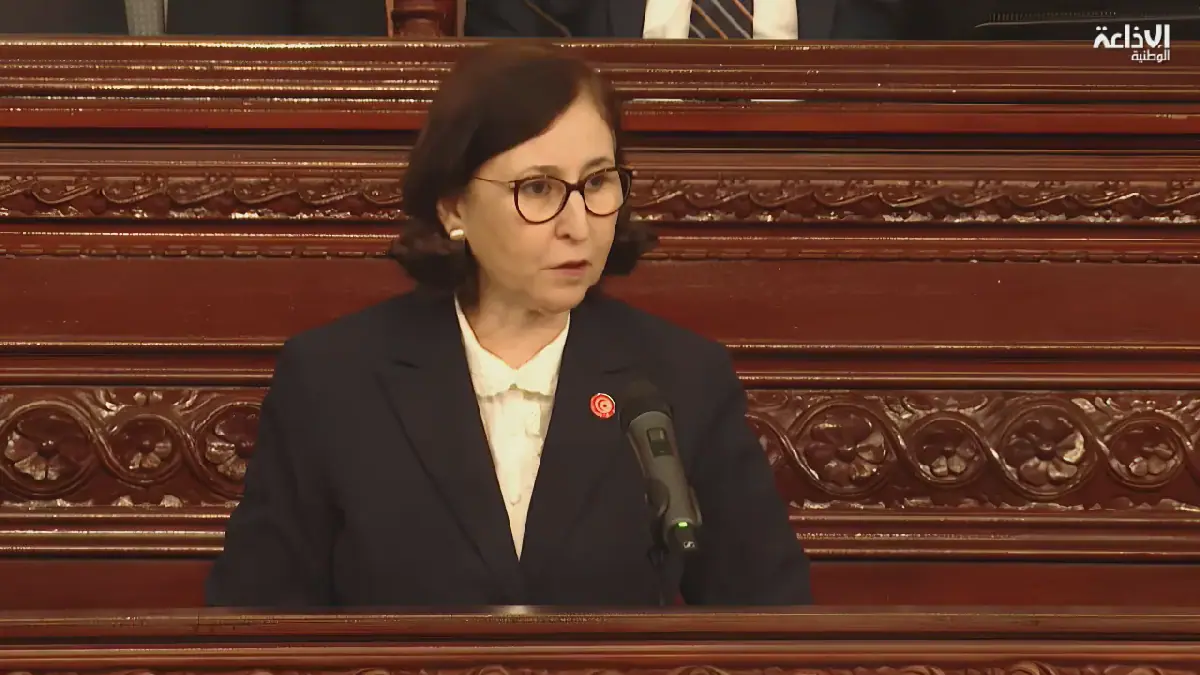
On November 9, 2026, Tunisian Prime Minister Sara Al-Zafrani Al-Zanzeri addressed the Tunisian parliament, providing an overview of the country's economic performance during 2026. Despite multiple crises and unprecedented shocks, the Tunisian economy has shown resilience, continuing its gradual recovery and regaining momentum. The Prime Minister cited improved performance in vital sectors such as agriculture, driven by increased grain and olive production, and services, boosted by a recovering tourism sector.
The Tunisian economy saw a 2.4% growth in gross domestic product (GDP) during the first half of 2026. The unemployment rate stood at 14.9% in the second quarter of 2026, down from 15% in the first quarter. The cumulative inflation rate reached 5.3% by the end of September 2026, down from 5.5% in the same period of 2025. The implicit inflation rate remained stable at 4.9%, matching the level recorded in August 2026.
Exports at current prices grew by 8% until the end of August 2026, driven by increased energy exports, particularly refined products, as well as agricultural and food products. The mechanical and electrical industries sector demonstrated its adaptability to external demand fluctuations, benefiting from integration into global value chains, diversified markets and products, and improved investment indicators.
Tourism revenues and remittances from Tunisians abroad increased by 4.5% and 5%, respectively, until September 30, 2026, compared to the same period in 2025. These figures reached approximately 6.3 billion dinars and 6.9 billion dinars, respectively. The Prime Minister emphasized that Tunisia has met its external obligations and maintained a reasonable level of foreign currency reserves, equivalent to 93 days, as of October 23, 2026.
Despite ongoing challenges, the Tunisian economy has demonstrated its ability to withstand pressure, with the dinar exchange rate showing overall stability as of September 2026. The country's sovereign rating remained stable during 2026, according to international rating agencies, reflecting the economy's resilience in the face of challenges.
Based on the results for the past period of 2026 and estimates for the remaining months, the government expects to achieve a growth rate of around 2.7% for the full year. The investment rate is projected to reach 15.5% of GDP, up from 15.4% in 2025. The current deficit is expected to be around 3.9% of GDP, compared to 2.5% in 2025, due to continued pressure on trade exchanges, particularly rising energy imports.
The government forecasts that the inflation rate will remain stable at around 5.3%, reflecting continued relative control over price growth. The Prime Minister's statement highlights the country's efforts to navigate complex global and regional challenges while maintaining economic stability and promoting growth in key sectors.
Key points
- The Tunisian economy is expected to grow by 2.7% in 2026, with an investment rate of 15.5% of GDP.
- The country's foreign currency reserves are equivalent to 93 days, as of October 23, 2026.
- The inflation rate is projected to remain stable at around 5.3% for 2026.