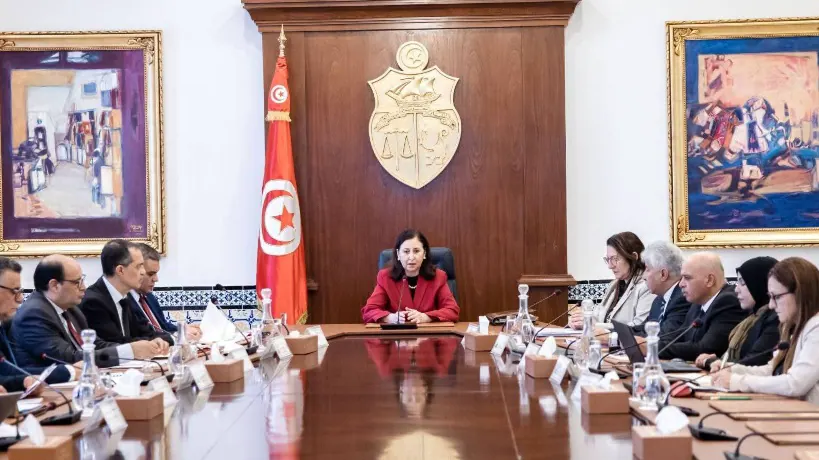
The Tunisian government, led by Prime Minister Sara Zenzari, held a cabinet meeting to discuss the development of cooperative companies and mechanisms for their support and accompaniment. The meeting, which took place at the Government Palace in Kasbah, focused on accelerating the creation of these companies and simplifying procedures. Zenzari emphasized that cooperative companies represent a national and strategic economic option aimed at establishing a new development model based on collective initiative, job creation, social justice, and equitable wealth distribution.
Zenzari highlighted that this economic approach, which starts from the base, creates real job opportunities by investing in local and regional resources and converting them into economic wealth through sustainable and competitive projects. She stressed that cooperative companies represent a direct and practical way to achieve development, combining the spirit of initiative, self-reliance, and adherence to participatory and social justice values. The Prime Minister also recalled that this model has been successfully implemented in many developed countries and has proven its effectiveness.
The meeting included a detailed presentation by Minister of Employment and Vocational Training, Riadh Chouad, and State Secretary for Cooperative Companies, Hanaa Jeballah, on the quantitative and qualitative achievements in the field of cooperative company governance. The presentation covered the simplification and unification of procedures, their digitalization through the updated national register, and the facilitation of access to financing, support, and accompaniment. The challenges and procedural issues were also discussed, and practical solutions were proposed.
The cabinet meeting resulted in several recommendations, including directing cooperative companies towards new vital sectors and markets, developing training and accompaniment mechanisms, and harmonizing training programs with company technical needs. The government also aims to develop and document integrated project ideas within the value chains of targeted economic sectors and include them in the project bank. The goal is to ensure sustainable economic and social returns.
The Prime Minister emphasized the importance of raising awareness about the significance of this economic model, which has proven successful in many developed countries. She highlighted its role in achieving social justice and ensuring a more equitable distribution of wealth. Zenzari also stressed the pivotal role of cooperative companies in providing job opportunities and creating wealth, particularly for young people.
The government aims to support local and regional development through cooperative companies, which will contribute to the production of wealth and the valorization of available resources in different regions. The Prime Minister called for the removal of obstacles at the central, regional, and local levels and the intensification of efforts by ministries, public structures, and concerned states.
The development of cooperative companies is part of the Tunisian government's efforts to promote a new economic model that prioritizes collective initiative, job creation, and social justice. The government is committed to supporting these companies and providing the necessary mechanisms for their success. By doing so, it aims to achieve sustainable economic and social development.
Key points
- The Tunisian government is committed to developing cooperative companies as a key part of its economic strategy.
- The government aims to simplify procedures and provide support and accompaniment to these companies.
- Cooperative companies are expected to play a significant role in job creation and wealth production in Tunisia.