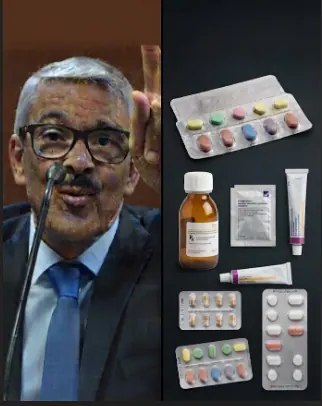
The Tunisian pharmaceutical industry has been growing steadily since the 1980s, with around 40 factories operating in the country. These factories produce medicines that meet international regulatory standards, with a portion of the production being exported to countries in the Maghreb, Arab and African regions, and Europe. According to Kamel Idir, president of the Tunisian Association of Generic Medicines (ATMG), the country's pharmaceutical sector has made significant progress.
Generic medicines manufactured in Tunisia offer a significant price advantage over their original counterparts, particularly when they are first launched. Idir stated that the price difference can range from 30% to 40%. However, this advantage tends to decrease over time due to the freezing of certain prices. Idir also noted that the industry faces challenges, including dependence on imported raw materials, components, and technologies.
The development of generic medicines is closely linked to the growth of domestic production, according to Idir. He emphasized that the country has a solid industrial base that can be leveraged to strengthen its autonomy in terms of medicines. Idir called for bolder decisions and greater trust in national capabilities to achieve greater self-sufficiency in pharmaceuticals.
Despite the growth of domestic production, the Tunisian pharmaceutical industry remains dependent on imports for some raw materials, components, and technologies. A report by BMI, a subsidiary of Fitch Solutions, estimated that the foreign value-added component in Tunisian pharmaceutical consumption was around 61%.
Idir also highlighted the need to boost patient confidence in generic medicines. He noted that these medicines are subject to regulatory requirements and must meet bioequivalence criteria with the reference medicine. The Tunisian regulatory framework includes bioequivalence studies in the authorization process for generic medicines.
To promote the use of generic medicines, Tunisia plans to present a project at the World Health Assembly in May 2027. The project aims to encourage the use of scientific denominations of medicines among healthcare professionals, allowing pharmacists to inform patients about the different available equivalents and their price differences.
The development of generic medicines in Tunisia has significant implications for purchasing power, domestic production, and pharmaceutical autonomy. Idir emphasized that preserving the price advantage of generic medicines over time requires an environment that allows industries to maintain their competitiveness and investments.
Key points
- Generic medicines in Tunisia can be 30-40% cheaper than original medicines.
- The Tunisian pharmaceutical industry remains dependent on imports for some raw materials and technologies.
- The country aims to strengthen its autonomy in pharmaceuticals through domestic production and regulatory frameworks.